
Masks and faces
1857–58
Medium
Lithograph in black on light gray China paper, laid down on ivory wove paper
Dimensions
Image: 20.2 × 16 cm (8 × 6 5/16 in.); Chine: 22.9 × 18.9 cm (9 1/16 × 7 1/2 in.); Sheet: 38.9 × 20.5 cm (15 3/8 × 8 1/8 in.)
Classification
lithograph
Department
Prints and Drawings
Museum
Art Institute of Chicago
Accession Number
11032
Rights
Public Domain
Art Historical Context
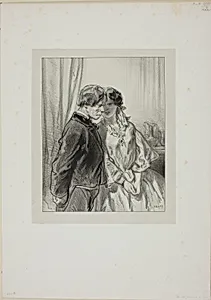
**Masks and Faces** Paul Gavarni, created between 1857 and 1858, invites visitors into the witty world of mid-19th-century Frenchmaking. This lithograph printed in black ink on delicate light gray China paper and laid down on ivory w paper, measures a compact image of 20.2 × 16 cm. Housed in the Art Institute of Chicago's Prints Drawings department, it exemplifies Gavarni's mastery of lithography—a revolutionary technique invented in the late 18th century allowed artists to draw directly on stone for fluid, expressive lines and subtle tones, perfect for reproducing intricate details affordably. Gavarni (1804–1866), a celebrated Parisian illustrator and caricaturist, was renowned for his sharp observations of urban life, fashion, and social satire in publications like *Le Charivari*. The evocative title *Masks and Faces* likely juxtaposes theatrical disguises with human expressions, reflecting the era's fascination with identity, performance, and the masks of high society during Napoleon III's Second Empire—a time of glittering boulevards and hidden social critiques. The use of China paper in a *chine collé* process here enhances the print's luminosity and texture, a sophisticated choice for fine art editions. This modest yet masterful work captures Gavarni's blend of elegance and irony, offering a window into 19th-century cultural masquerades that still resonates today. (198 words)
About the Artist
Paul Gavarni · 1804–1866
Paul Gavarni, born Sulpice Guillaume Chevalier on January 13, 1804, in Paris to a cooper father from Burgundy and mother Marie-Monique Thiémet—whose brother, painter Guillaume Thiémet, served as his godfather—began his career far from the art world. As a youth, he worked in a machine factory and studied mechanical drawing at the Conservatoire des Arts et Métiers in 1818, followed by evening classe...