
Mathilde (autre)
1860s
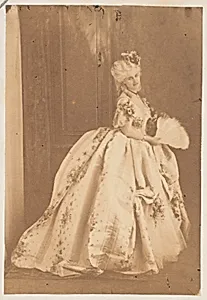
Medium
Albumen silver print from glass negative
Classification
Photographs
Department
Photographs
Museum
Metropolitan Museum of Art, New York, NY
Credit
David Hunter McAlpin Fund, 1975
Accession Number
1975.548.84
Rights
Public Domain
Tags
Art Historical Context
In the glittering world of 1860s Paris, Pierre-Louis Pierson captured essence of high society with *Mathilde (aut)*, an albumen silver print from a negative now housed in the Metropolitan Museum Art's Photographs department. intimate portrait features a poised woman gracefully holding a fan, a quintessential accessory symbolizing elegance, flirtation, and status during the Second French Empire. Acquired through the David Hunter McAlpin Fund 1975, it the era's fascination with personal identity through photography. Pierson, a prominent French photographer linked to the House of Worth fashion house, mastered the albumen process—a technique using egg-white-coated paper sensitized with silver salts. This method, dominant from the 1850s to 1890s, yielded warm, detailed tones and subtle gradations ideal for cartes de visite, the pocket-sized portraits exchanged among the elite. The glass negative allowed for multiple high-quality prints, democratizing access to such refined imagery. Culturally, works like this highlight women's roles in imperial fashion and portraiture, where fans served as both practical tools and emblems of refinement. *Mathilde (autre)*—suggesting a variant pose or study—invites us to ponder the subject's story, blending artistry with the social rituals of 19th-century Europe.
About the Artist
Pierre-Louis Pierson · 1822–1913
Pierre-Louis Pierson (1822–1913) was a pioneering French portrait photographer whose career spanned the formative years of the medium. Born on December 13, 1822, in Hinckange in the Moselle department, Pierson developed an early fascination with photography during the 1840s, as the daguerreotype was still in its infancy. His early life and formal training remain sparsely documented, but by 1844, h...