
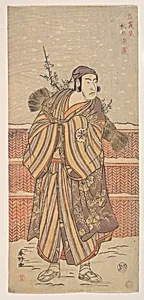
Matsumoto Sumezō as a Man in Winter Attire Standing in the Snow
ca. 1785–90
Medium
Woodblock print; ink and color on paper
Dimensions
Overall: 12 1/4 x 5 9/16in. (31.1 x 14.1cm)
Classification
Prints
Culture & Period
Japan · Edo period (1615–1868)
Department
Asian Art
Museum
Metropolitan Museum of Art, New York, NY
Credit
Purchase, Joseph Pulitzer Bequest, 1918
Accession Number
JP287
Rights
Public Domain
Tags
Art Historical Context
In the snowy hush of Edo-period Japan, Katsukawa Shō captures the poised elegance of Kabuki actor Matsumoto Sumezō in this striking woodblock print from around 1785–90. Titled *Matsumoto Sumezō as a Man in Winter Attire in the Snow*, the image portrays the performer dressed in layered robes, standing resolutely amid falling flakes. Shunkō, a master of the uyo-e ("pictures of the floating world") school, specialized in yakusha-e—vibrant portraits of actors that blurred the line between stage and everyday life, immortalizing theater stars as cultural icons. This *ōban* format print (roughly 12¼ x 5⅝ inches) exemplifies the technical brilliance of woodblock printing: intricate carving allowed for bold colors, subtle gradations (*bokashi*), and delicate snow effects, achieved through multiple carved blocks and hand-rubbed inks. During Japan's Edo period (1615–1868), such affordable prints democratized art, fueling a craze for Kabuki imagery amid urban prosperity in cities like Edo (modern Tokyo). Housed in the Metropolitan Museum of Art's Asian Art collection, this work highlights ukiyo-e's cultural pulse—celebrating transience, beauty, and performance in a wintry tableau that evokes both stoic resilience and theatrical drama. A window into 18th-century Japan's vibrant theater scene!
About the Artist
Katsukawa Shunkō · 1743–1812
Katsukawa Shunkō I (1743–1812) was a Japanese ukiyo-e artist who pioneered the ōkubi-e (large-head) portrait format in kabuki actor prints and served as possibly the first student of Katsukawa Shunshō, the founder of the influential Katsukawa school. Born in 1743, Shunkō spent his entire life in Edo (modern Tokyo), working as both a painter and ukiyo-e printmaker specializing in yakusha-e (actor p...