
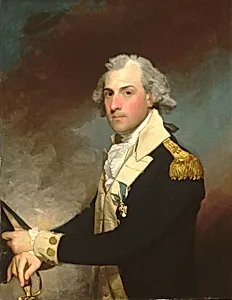
Matthew Clarkson
ca. 1794
Medium
Oil on canvas
Dimensions
36 1/16 x 28 1/4 in. (91.6 x 71.8 cm)
Classification
Painting
Culture
American
Department
The American Wing
Museum
Metropolitan Museum of Art, New York, NY
Credit
Bequest of Helen Shelton Clarkson, 1937
Accession Number
38.61
Rights
Public Domain
Tags
Art Historical Context
Gilbert Stuart's *Matthew Clarkson* (ca. 1794) is a striking oil-on-canvas portrait capturing the poised elegance of a prominent New York merchant during the early years of the American Republic. Measuring 36 1/16 x 28 1/4 inches, this work exemplifies Stuart's mastery in the neoclassical portrait tradition, where he blended European influences with a distinctly American vitality. Painted just after the ratification of the U.S. Constitution, it reflects the rising merchant class's self-assured identity in a young nation forging its cultural independence. Stuart, one of America's foremost portraitists—best known for his iconic images of George Washington—employed his signature loose brushwork and luminous skin tones to convey psychological depth. Here, Clarkson's direct gaze and formal attire, likely including a powdered wig and dark coat, evoke the Federal-era sophistication, while subtle modeling brings a lifelike warmth to the canvas. Oil on canvas allowed Stuart to achieve rich textures and dramatic lighting, hallmarks of his style that influenced generations of American painters. Housed in The Metropolitan Museum of Art's American Wing, this bequest from Helen Shelton Clarkson in 1937 preserves a window into 18th-century elite life, highlighting how portraiture served as both personal commemoration and social statement in post-Revolutionary America.
About the Artist
Gilbert Stuart · 1755–1828
Gilbert Stuart (1755–1828) was born on December 3, 1755, in Saunderstown, Rhode Island. He received his first painting instruction from local portraitist Samuel King, then studied under Scottish artist Cosmo Alexander who brought him to Scotland in 1771. After Alexander died, Stuart returned to Newport before sailing to London in 1775, where he entered the studio of Benjamin West for approximately...