
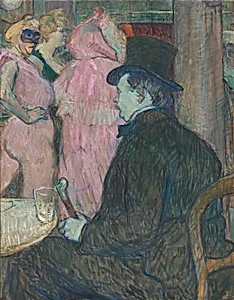
Maxime Dethomas
Medium
oil on cardboard
Dimensions
overall: 67.5 x 50.9 cm (26 9/16 x 20 1/16 in.) framed: 99.1 x 87 cm (39 x 34 1/4 in.)
Classification
Painting
Department
CF
Museum
National Gallery of Art, Washington, D.C.
Credit
Chester Dale Collection
Accession Number
1963.10.219
Rights
Public Domain
Art Historical Context
Henri de Toulouse-Lautrec's *Maxime Dethomas* (1896) is a striking portrait capturing the essence of fin-de-siècle Paris. Painted in oil on cardboard—a medium Lautrec favored for its affordability and portability—this intimate work measures 67.5 x 50.9 cm and depicts fellow artist Maxime Dethomas, a talented illustrator and close friend. Lautrec, a master of Post-Impressionism, often portrayed the bohemian circles of Montmartre, blending sharp observation with psychological depth. The choice of cardboard underscores Lautrec's innovative techniques, allowing for bold, fluid brushstrokes that convey immediacy and spontaneity. Created at the peak of his career, the painting reflects the vibrant cultural scene of 1890s France, where artists like Dethomas and Lautrec pushed boundaries amid the Belle Époque's artistic fervor. Its loose handling of form and rich color palette highlight Lautrec's departure from academic traditions, favoring expressive distortion to reveal character. Now housed in the National Gallery of Art as part of the Chester Dale Collection, this piece exemplifies Lautrec's genius for portraiture, offering visitors a window into the camaraderie and creativity of Paris's avant-garde world.
About the Artist
Henri de Toulouse-Lautrec · 1864–1901
Henri Marie Raymond de Toulouse-Lautrec-Montfa (1864-1901) was a French Post-Impressionist painter, printmaker, and illustrator whose innovative poster designs revolutionized graphic art and advertising in late 19th-century Paris. Born into an aristocratic family at Albi in southern France, Toulouse-Lautrec's privileged lineage traced back to the Counts of Toulouse and extended uninterrupted to th...