
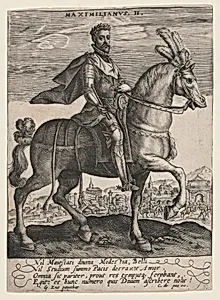
Maximilianus II
Medium
engraving on laid paper
Dimensions
sheet: 14 × 10.2 cm (5 1/2 × 4 in.) cut within platemark
Classification
Department
CG-E
Museum
National Gallery of Art, Washington, D.C.
Credit
Gift of John O'Brien
Accession Number
2012.122.8
Rights
Public Domain
Art Historical Context
Behold the intricate engraving *Maximilianus II* by Crispijn van de Passe I, created in 1604 and now housed in the National Gallery of Art. This small-scale portrait (14 × 10.2 cm) captures Holy Roman Emperor Maximilian II (r. 1564–1576), a pivotal figure during the Renaissance whose reign bridged religious tensions in Europe. Van de Passe, a leading Dutch engraver from a renowned family of printmakers, produced this posthumous likeness nearly three decades after the emperor's death, reflecting the enduring fascination with Habsburg rulers. Crafted as an engraving on laid paper—a technique where a burin carves fine lines into a copper plate for inking and printing—this work exemplifies the precision of Northern Mannerist printmaking. The modest dimensions and cut edges suggest it was designed for collectors' albums or emblem books, making elite imagery accessible beyond paintings. Van de Passe's mastery shines in the delicate line work, evoking texture and depth in a compact format. Such prints held cultural weight in the early 17th century, serving as diplomatic tools, historical records, and status symbols. Gifted to the museum by John O'Brien, this piece invites us to ponder how engraving democratized portraiture, preserving Maximilian's legacy amid Europe's shifting powers. A testament to artistry's power to transcend time.