
Frederick, King of Bohemia
1551 to 1600
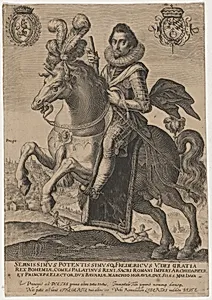
Medium
engraving
Dimensions
sheet: 36 × 25.1 cm (14 3/16 × 9 7/8 in.)
Classification
Department
CG-E
Museum
National Gallery of Art, Washington, D.C.
Credit
Rosenwald Collection
Accession Number
1950.14.490
Rights
Public Domain
Art Historical Context
Welcome to the National Gallery of, where we spotlight *Frederick, King of Bohemia*, a striking engraving by Crispijn de I, created between 1551 and 1600. Measuring 36 × 25.1 cm, this print from the Rosenwald Collection captures the likeness of Frederick V, the-lived "Winter King" who was elected King of Bohemia in 161 amid Protestant resistance to Habsburg rule. His brief reign marked the explosive start of the Thirty Years War, making this portrait a window into the turbulent politics of early modern Europe. Crispijn de Passe I, a master Dutch engraver from a renowned family of printmakers, excelled in detailed reproductive prints that popularized images of royalty and nobility. Engraving, an intaglio technique where lines are incised into a metal plate and inked, allowed for exceptional precision and tonal depth—ideal for conveying regal authority through fine lines, textures, and shading. These prints were widely circulated, serving as both art and propaganda in an era when visual likenesses shaped public perception of leaders. This work exemplifies the Renaissance-to-Baroque transition in printmaking, blending technical virtuosity with historical resonance. As visitors, imagine holding a piece of 17th-century diplomacy in your hands—timeless yet tied to the powder keg of Europe's religious wars. (198 words)
About the Artist
Crispijn de Passe I
Crispijn de Passe I, born around 1564 in Arnemuiden, Zeeland, emerged as one of the most influential Dutch engravers and print publishers of his era. He relocated to Antwerp as a youth, where he honed his craft amid the city's vibrant printmaking scene, becoming an independent master in the Guild of Saint Luke by 1584–1585. There, he worked as a reproductive engraver, primarily after designs by pr...