
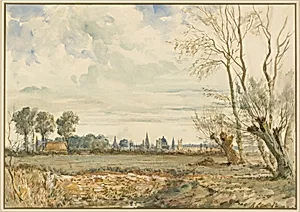
Meadows with a Distant View of Oxford
1830s
Medium
graphite and watercolor touched with white gouache on wove paper
Dimensions
overall: 29 x 41.5 cm (11 7/16 x 16 5/16 in.)
Classification
Drawing
Department
CG-E
Museum
National Gallery of Art, Washington, D.C.
Credit
Gift of Mimi and Sanford Feld
Accession Number
2005.143.1
Rights
Public Domain
Art Historical Context
In the 1830s, British artist Thomas Shotter Boys created this serene landscape, capturing expansive meadows that lead the eye toward the distant skyline of Oxford. The view evokes the quiet charm of the English countryside during a period of rapid social change, inviting viewers to appreciate the harmony between open nature and the historic university town. Boys worked in graphite and watercolor touched with white gouache on wove paper, a combination that allowed for both precise architectural detail in the far-off buildings and soft, atmospheric effects in the fields and sky. The translucent washes create a luminous quality typical of early nineteenth-century British watercolor practice, while the gouache highlights add subtle brightness and texture. Measuring just under twelve by seventeen inches, the drawing rewards close looking and reflects the era’s growing interest in topographical views that blended accuracy with poetic feeling. Now part of the National Gallery of Art’s collection through the generosity of Mimi and Sanford Feld, it offers visitors a gentle window onto the landscapes that shaped Romantic-era Britain.
About the Artist
Thomas Shotter Boys · 1803–1874
Thomas Shotter Boys was born on 2 January 1803 in Pentonville, London, and received his first professional training as an apprentice to the engraver George Cooke. When his apprenticeship concluded he crossed the Channel to Paris, a move that would transform his artistic direction entirely. There he encountered Richard Parkes Bonington, the brilliant English watercolourist whose fresh, luminous ren...