
Medal of John Quincy Adams
1825
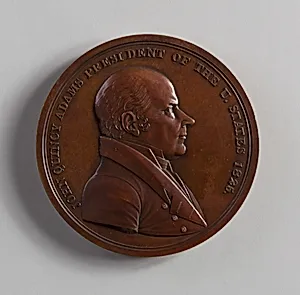
Medium
Bronze
Dimensions
Diam. 2 7/16 in. (6.2 cm)
Classification
Medal
Culture
American
Department
The American Wing
Museum
Metropolitan Museum of Art, New York, NY
Credit
Gift of William H. Huntington, 1883
Accession Number
83.2.429
Rights
Public Domain
Tags
Art Historical Context
This bronze medal, struck in 1825 by engraver Moritz Fürst, the dignified profile of John Quincy Adams the sixth President of the United States, as he assumed office following his election victory. Measuring a modest 2 7/16 inches in diameter, exemplifies the neoclassical portrait medals popular in the early 19th century, blending fine artistry with commemorative purpose. Adams, son of Founding Father John Adams, represented continuity in American leadership during a time of national expansion and political debate over issues like infrastructure and tariffs. Fürst, a skilled medalist likely trained in the European tradition of intaglio engraving, employed precise techniques to render Adams' noble features—strong jaw, receding hairline, and resolute gaze—on the obverse, evoking ancient Roman coins. The bronze medium lent durability and a warm patina, making these medals prized keepsakes for collectors and patriots alike. Housed in The American Wing of The Metropolitan Museum of Art since its 1883 gift by William H. Huntington, it highlights the era's fusion of European craftsmanship with emerging American identity. Such medals were not mere trinkets but portable symbols of prestige, bridging numismatics and sculpture to celebrate democratic ideals. Visitors will appreciate its intimate scale, inviting close inspection of the intricate details that immortalize a pivotal figure in U.S. history.
About the Artist
Moritz Fürst · 1782–1882
Moritz Fürst was a Hungarian-born engraver and medalist who became one of the most accomplished practitioners of his craft in the early United States. Born in Hungary in 1782, he acquired his technical training in European ateliers before emigrating to America, where he arrived in the early years of the nineteenth century and ultimately settled in Philadelphia — then the center of the young nation...