
Medallion
18th century
Medium
Glass paste
Dimensions
Overall: 1 3/4 × 1 1/8 in. (4.4 × 2.9 cm)
Classification
Glass
Culture
British, London
Department
European Sculpture and Decorative Arts
Museum
Metropolitan Museum of Art, New York, NY
Credit
Bequest of Mary Clark Thompson, 1923
Accession Number
24.80.56
Rights
Public Domain
Tags
Art Historical Context
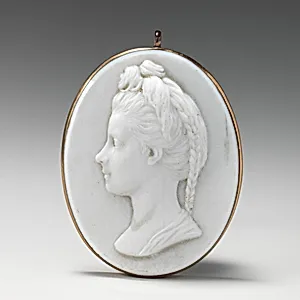
This delicate *Medallion* by James Tassie, in the 18th, exemplifies the Scottish artist's mastery of glass paste—a innovative medium that mimicked the luster and durability of ancient gems and cameos. Measuring just 1 3/4 × 1 1/8 inches, this petite British work from London features a finely engraved female profile, capturing the classical ideal of beauty with elegant lines and subtle modeling. Tassie's glass paste, a fine vitreous compound fired to porcelain-like hardness, allowed for intricate details rivaling precious stones, making high art accessible beyond the elite. In the Enlightenment era, Tassie's medallions surged in popularity amid a fervor for Greco-Roman antiquities. Collectors, scholars, and museums prized his reproductions for study and display, as they preserved the essence of lost originals without fragility. This piece, housed in the Metropolitan Museum of Art's European Sculpture and Decorative Arts department (bequest of Mary Clark Thompson, 1923), highlights glass paste's role in democratizing classical portraiture, blending technical innovation with cultural reverence for women's idealized profiles in profile medallions. Visitors will appreciate how Tassie's technique bridged art and science, turning humble glass into timeless treasures that still evoke the grandeur of ancient Rome.
About the Artist
James Tassie · 1735–1799
James Tassie (1735–1799) was a Scottish modeler and gem engraver who became one of the most celebrated producers of portrait medallions and reproductions of antique gems in eighteenth-century Europe. Born near Glasgow, Tassie initially trained as a mason's apprentice before his artistic talents drew him toward finer work. Moving to Dublin, he collaborated with the physician and amateur chemist Hen...