
Medallion and Animal Carpet
Medium
wool pile on silk warp and wool and cotton weft
Dimensions
overall: 437 x 225 cm (172 1/16 x 88 9/16 in.)
Classification
Decorative Art
Department
CSD
Museum
National Gallery of Art, Washington, D.C.
Credit
Widener Collection
Accession Number
1942.9.477
Rights
Public Domain
Art Historical Context
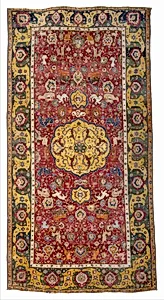
Step into the opulent world of Safavid Persia with the *Medallion and Animal Carpet possibly woven in Isfahan around 1600. This magnificent piece, measuring over 4 meters long and nearly 2.25 meters wide, exemplifies the of 17th-century Persian carpet. Crafted with a luxurious wool pile on a silk warp and wool-and-cotton weft, fine structure—achieved through meticulous knotting—allowed for intricate patterns that rivaled the finest court productions. Isfahan, a thriving hub under Shah Abbas I, was renowned for such carpets, blending technical mastery with aesthetic splendor. The design features a central medallion, a hallmark of classical Persian rugs symbolizing cosmic harmony, surrounded by lively animal motifs that evoke the natural world and mythical narratives. These elements not only showcase the weavers' skill in asymmetrical patterns and vibrant dyes but also reflect the cultural prestige of carpets as status symbols in royal palaces and diplomatic gifts. The silk warp, a rare and costly feature, underscores its elite commissioning, likely for a wealthy patron. Now part of the Widener Collection at the National Gallery of Art's Department of CSD (Carpets and Related Decorative Arts), this carpet invites visitors to ponder the enduring legacy of Persian decorative arts—where every knot tells a story of innovation, beauty, and cross-cultural exchange.