
Medallion from a Coffret
Unknown Artist
ca. 1210
Medium
Copper: pierced, repoussé, chased, engraved, scraped, stamped, and gilt; champlevé enamel: medium blue and red.
Dimensions
Overall: 3 1/4 x 3/16 in. (8.2 x 0.4 cm)
Classification
Enamels-Champlevé
Culture
French
Department
Medieval Art
Museum
Metropolitan Museum of Art, New York, NY
Credit
Gift of J. Pierpont Morgan, 1917
Accession Number
17.190.794
Rights
Public Domain
Tags
Art Historical Context
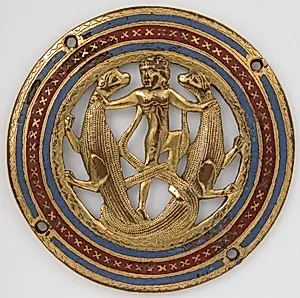
This exquisite medallion, dating to around 1210, hails from medieval France and once adorned a *coffret*—a small, ornate box likely used for relics, jewels, or devotional items. Crafted by an unknown artist, it exemplifies the Gothic era's fascination with intricate metalwork and vibrant enamels, blending technical mastery with symbolic storytelling. Measuring just over 3 inches across, its diminutive size belies its grandeur, featuring motifs of men and dragons that evoke chivalric tales or biblical struggles between virtue and vice, common in 13th-century art. The medallion's copper base undergoes a virtuoso array of techniques: pierced for openwork patterns, repoussé and chased to raise and refine motifs, engraved and scraped for fine details, stamped for texture, and gilt for a golden sheen. Over this, champlevé enamel in rich medium blue and red fills carved cells, fired to create durable, jewel-like colors. This labor-intensive process, peaking in the Limoges region, made enamels a prized medium for portable luxury objects, bridging sculpture and jewelry. Housed in The Metropolitan Museum of Art's Medieval Art department thanks to J. Pierpont Morgan's 1917 gift, this piece offers a window into the devotional life of high medieval Europe, where such artifacts fused artistry with spirituality for elite patrons.