
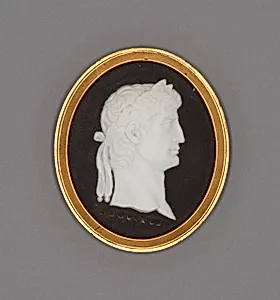
Medallion with Augustus
Late 18th century
Medium
Stoneware (jasperware)
Dimensions
5.9 × 5.1 × 0.8 cm (2 5/16 × 2 × 11 in.)
Classification
sculpture
Department
Applied Arts of Europe
Museum
Art Institute of Chicago
Accession Number
67978
Rights
Public Domain
Art Historical Context
This delicate medallion from the Wedgwood Manufactory crafted in the late 18 century, captures the profile of Augustus, Rome's first emperor, in exquisite jasperware stoneware. Measuring just 5.9 × 5.1 × 0.8 cm, this small-scale sculpture exemplifies the British firm's mastery of neoclassical design, blending ancient grandeur with industrial innovation. Jasperware, Wedgwood's signature medium, features a matte, colored body—often the iconic blue—embellished with finely modeled white clay reliefs that seem to emerge from the surface like classical cameos. Developed by Josiah Wedgwood in the 1770s, jasperware revolutionized ceramics by mimicking the prized Portland Vase and other Greco-Roman artifacts, making high art accessible through repeatable production techniques. During the Enlightenment era, such pieces fueled a craze for antiquity among Europe's elite, serving as jewelry pendants, snuffbox fittings, or cabinet decorations. This medallion reflects that cultural revival, immortalizing Augustus as a symbol of imperial power and enlightened rule. Housed in the Art Institute of Chicago's Department of Applied Arts of Europe, it highlights Wedgwood's role in elevating pottery to fine art, bridging ancient history with Georgian elegance. A testament to precision and taste, it invites visitors to ponder how a tiny object could embody empires past.
About the Artist
Wedgwood Manufactory
Wedgwood Manufactory, founded on 1 May 1759 by Josiah Wedgwood in Burslem, Staffordshire, England, revolutionized ceramics during the Industrial Revolution. Born into a family of potters, Josiah apprenticed under his elder brother Thomas at the Churchyard Works from age 14, mastering traditional techniques before partnering with Thomas Whieldon from 1754 to 1759, where he honed innovative glazes. ...