
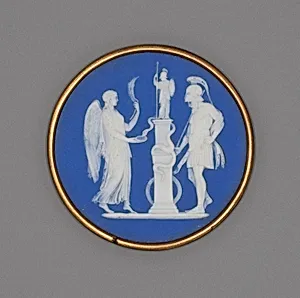
Medallion with Warrior and Priestess
Late 18th century
Medium
Stoneware (jasperware)
Dimensions
Diam.: 6.4 cm (2 1/2 in.)
Classification
sculpture
Department
Applied Arts of Europe
Museum
Art Institute of Chicago
Accession Number
68225
Rights
Public Domain
Art Historical Context
This delicate medallion, crafted by the Wedgwood Manufactory in the late 18th century, exemplifies the refined elegance of neoclassical design. Measuring just 2½ inches across, the small stoneware piece in jasperware features a white relief scene of a warrior and priestess against a colored ground. Wedgwood’s innovative ceramic technique produced a matte, unglazed surface that mimicked the look of ancient cameos and gems, allowing intricate details to stand out with striking clarity. Jasperware became hugely popular during the Enlightenment, when European interest in classical antiquity reached new heights. Josiah Wedgwood’s factory drew inspiration from Greek and Roman art, often depicting mythological or historical figures to appeal to educated collectors. This medallion’s compact size suggests it may have been intended for display in a cabinet or as part of a larger decorative scheme, reflecting the period’s taste for intimate, scholarly objects. As a work of applied art now in the Art Institute of Chicago’s European collection, it highlights how industrial innovation and artistic ambition combined to bring classical ideals into everyday domestic settings. The crisp modeling and balanced composition demonstrate the high technical standards that made Wedgwood synonymous with neoclassical ceramics.
About the Artist
Wedgwood Manufactory
Wedgwood Manufactory, founded on 1 May 1759 by Josiah Wedgwood in Burslem, Staffordshire, England, revolutionized ceramics during the Industrial Revolution. Born into a family of potters, Josiah apprenticed under his elder brother Thomas at the Churchyard Works from age 14, mastering traditional techniques before partnering with Thomas Whieldon from 1754 to 1759, where he honed innovative glazes. ...