
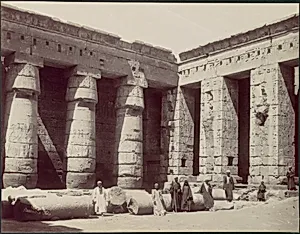
Medinet Habou, 2me cour cote sudouest
1870s
Medium
Albumen silver print from glass negative
Classification
Photographs
Department
Photographs
Museum
Metropolitan Museum of Art, New York, NY
Credit
Gift of Mrs. John L. Swayze, 1981
Accession Number
1981.1194.1
Rights
Public Domain
Tags
Art Historical Context
Step into the sun-drenched grandeur of ancient Egypt with *Medinet Habou, 2me cour cote sudouest a captivating albumen silver print from 1870s by Antonio Beato. This photograph captures the southwest side of the second court at Medinet Habu, the mortuary temple complex ofesses III near Luxor. Beato, an Italian-British photographer renowned for his meticulous documentation of Egyptian antiquities during the Victorian era, expertly frames the towering pylons, intricate carvings, and architectural details that evoke the power of New Kingdom pharaonic Egypt. The albumen silver print, made from a glass negative, was a hallmark of 19th-century photography, prized for its rich tonal range and sharp clarity that brought distant wonders to European audiences. Beato's images, often featuring local men amidst the ruins, bridged the gap between East and West, fueling Egyptomania and scholarly interest in archaeology. This work highlights human scale against monumental stone, with figures possibly workers or guides adding life to the timeless scene. Today, housed in the Metropolitan Museum of Art's Photographs Department (gift of Mrs. John L. Swayze, 1981), it reminds us how photography preserved Egypt's legacy amid rapid 19th-century exploration and preservation efforts. A window to a bygone empire!