
Meditation (La meditation)
1826 to 1850
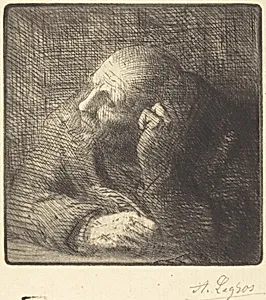
Medium
etching? and drypoint
Classification
Department
CG-E
Museum
National Gallery of Art, Washington, D.C.
Credit
Rosenwald Collection
Accession Number
1943.3.5336
Rights
Public Domain
Art Historical Context
**Meditation (La méditation)** by Alphonse Legros visitors into the introspective world of 19th-century printmaking. Created between 1826 and 1850, this etching andpoint exemplifies Legros's mastery of intaglio techniques during his early career. As a key figure bridging Realism and the etching revival, Legros drew inspiration from masters like Rembrandt, producing works that blend precise linework with emotional depth. Housed in the National Gallery of Art'swald Collection—a treasure trove of graphic arts—this print highlights the era's fascination with contemplative themes. Etching involves coating a metal plate with acid-resistant ground, scratching designs, and immersing in acid to etch lines, while drypoint adds a tactile burr for velvety, expressive strokes. Together, these methods allowed Legros to achieve rich tonal contrasts and subtle textures, making prints like *Meditation* affordable yet artistically profound alternatives to paintings. This piece reflects the technical innovation of the time, when printmakers elevated the medium to fine art. Part of the Prints department (CG-E), *Meditation* underscores the cultural shift toward intimate, personal expression in European art. Whether pondering a serene figure lost in thought, it captivates with its quiet intensity, offering modern viewers a window into Victorian-era introspection. A must-see for print enthusiasts! (198 words)
About the Artist
Alphonse Legros · 1837–1911
Alphonse Legros (1837–1911) was born in Dijon, France, and trained in Paris at the drawing school of Horace Lecoq de Boisbaudran, whose unconventional teaching method — which emphasised memory drawing and acute observation over academic convention — would leave a lasting mark on Legros's practice. At Lecoq's school he formed friendships with Jules Dalou and Auguste Rodin that endured throughout hi...