
Meditation
1920
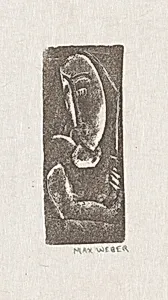
Medium
linocut in black on laid paper
Dimensions
image: 6.67 × 2.86 cm (2 5/8 × 1 1/8 in.) sheet: 25.4 × 16.51 cm (10 × 6 1/2 in.)
Classification
Department
CG-W
Museum
National Gallery of Art, Washington, D.C.
Credit
Gift of Jack and Margrit Vanderryn
Accession Number
2015.114.17
Rights
Public Domain
Art Historical Context
**Meditation** (1920) by Max is a striking linocut in black ink on laid paper, capturing a moment of quiet introspection in a compact image measuring just 6.67 × 2.86 cm. The larger sheet (25.4 × 16.51 cm) frames this intimate print, now housed in the National Gallery Art's Department of Prints (CG-W) as a generous gift from Jack and Margrit Vanderryn. Created during the vibrant post-World War I era, when American modernism was blossoming, Weber—a Russian-born artist who became a key figure in New York's avant-garde—employed the linocut technique to distill contemplative forms with bold, simplified lines. Linocut, a relief printing method using linoleum blocks, allowed Weber to achieve dramatic contrasts and graphic intensity, hallmarks of early 20th-century printmaking. This medium democratized art, making bold modernist experiments accessible beyond oil paintings. Weber's style here echoes his broader influences from Cubism and Expressionism, reducing the meditative figure to essential shapes that evoke spiritual depth amid the era's social upheavals. Though small in scale, *Meditation* invites visitors to pause and reflect, mirroring its subject. It exemplifies how prints bridged fine art and everyday contemplation, showcasing Weber's innovative spirit in a format perfect for personal collections. A gem for print enthusiasts! (198 words)
About the Artist
Max Weber · 1881–1961
Max Weber (1881–1961), born in Białystok in the Russian Empire (now Poland) to Orthodox Jewish parents, immigrated to Brooklyn, New York, at age ten with his family, joining his tailor father.) There, he pursued art studies at the Pratt Institute under Arthur Wesley Dow, an innovative teacher who emphasized expression and form over traditional narrative, drawing from Japanese art and Paul Gauguin....