
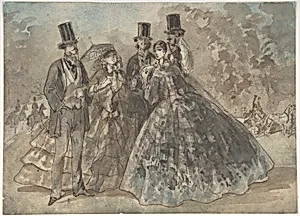
Meeting in the Park
ca. 1860
Medium
Pen and brown ink, brush and gray, blue, and black wash
Dimensions
8 9/16 x 11 13/16 in. (21.7 x 30 cm)
Classification
Drawings
Department
Drawings and Prints
Museum
Metropolitan Museum of Art, New York, NY
Credit
Rogers Fund, 1937
Accession Number
37.165.98
Rights
Public Domain
Tags
Art Historical Context
**Meeting in the Park**, created around 1860 by Constantin Guys captures a lively moment of Parisian social life during the Second Empire. Guys, often hailed by poet Charles Baudelaire as the "painter of modern," specialized in spontaneous sketches of urban elegance—fashionable women in crinolines, dapper men, and bustling public spaces like parks. This drawing likely depicts a chance encounter amid the leafy promenades of Paris's newly renovated green oases, such as the Bois de Boulogne, where the elite flaunted the latest styles under Napoleon III's glittering regime. Rendered in pen and brown ink with brush and gray, blue, and black washes on paper (8 9/16 x 11 13/16 in.), the work showcases Guys' masterful technique for evoking movement and atmosphere. The fluid ink lines suggest rapid observation, while subtle washes add depth and coloristic nuance, mimicking the dappled light of a sunny afternoon. As a precursor to Impressionism, Guys' economical style prioritized the ephemeral over the monumental, influencing later artists like Degas and Toulouse-Lautrec. Acquired through the Rogers Fund in 1937, this piece from The Metropolitan Museum of Art's Drawings and Prints collection invites us to glimpse 19th-century leisure—a timeless reminder of how parks have long served as stages for human connection.
About the Artist
Constantin Guys · 1802–1892
Constantin Guys, born Ernest-Adolphe-Hyacinthe-Constantin Guys de Saint-Hélène on December 3, 1802, in Vlissingen, Netherlands, to French parents François Lazare Guys and Elisabeth Bétin, spent his early years in a naval family that relocated to Calais around 1805. His early life is not well documented, with no records of formal art training, teachers, or schools; Guys appears to have been largely...