
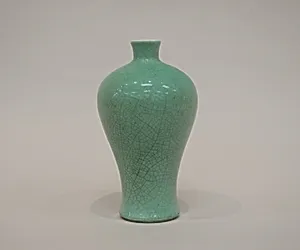
Meiping vase
Unknown Artist
early 18th century
Medium
Porcelain with crackled green glaze (Jingdezhen ware)
Dimensions
H. 9 in. (22.9 cm); Diam. 5 in. (12.7 cm)
Classification
Ceramics
Culture & Period
China · Qing dynasty (1644–1911), Kangxi period (1662–1722)
Department
Asian Art
Museum
Metropolitan Museum of Art, New York, NY
Credit
Bequest of Benjamin Altman, 1913
Accession Number
14.40.347
Rights
Public Domain
Art Historical Context
Behold the elegant Meiping vase, a exquisite example of early 18th-century Chinese porcelain from the Kangxi period (1662–1722) of the Qing dynasty (1644–1911). Standing at just 9 inches tall with a 5-inch diameter, this pear-shaped vessel—known as a *meiping*—features a graceful swollen body tapering to a narrow neck, originally designed to hold wine or slender flower stems. Crafted in Jingdezhen, China's renowned porcelain capital, it exemplifies the imperial kilns' mastery during a golden age of ceramic production. The vase's standout feature is its crackled green glaze, a celadon-type finish where fine, intentional fissures create a textured, ice-like pattern that enhances its luminous depth. This technique, perfected in Jingdezhen, reflects the era's innovative glazing methods and aesthetic appreciation for subtle imperfection, evoking nature's beauty. Kangxi reign porcelain like this was prized for its technical refinement, often exported worldwide, symbolizing China's cultural prestige. Now part of the Metropolitan Museum of Art's Asian Art collection, thanks to the 1913 bequest of Benjamin Altman, this anonymous masterpiece invites us to ponder the artistry of unseen hands—timeless vessels that bridged courts, scholars, and collectors across centuries.