
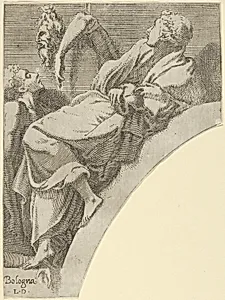
Melpomene, from "Twelve Muses and Goddesses"
ca. 1540–45
Medium
Etching
Dimensions
Sheet (trimmed): 7 15/16 × 5 7/8 in. (20.2 × 15 cm)
Classification
Prints
Department
Drawings and Prints
Museum
Metropolitan Museum of Art, New York, NY
Credit
The Elisha Whittelsey Collection, The Elisha Whittelsey Fund, 1949
Accession Number
49.97.562
Rights
Public Domain
Tags
Art Historical Context
Behold *Melpomene, from "Twelve Muses andes"*, an exquisite etching by Francesco Primatic, with engraving by Léon Davent, around 1540–45. Melpomene, the ancient Greek Muse of tragedy, elegantly rendered here as a poised female figure, embodying the dramatic pathos of theatrical performance. This print is part of a celebrated series that pairs the Nine Muses with three goddesses, blending classical mythology with Renaissance humanism to celebrate the arts and divine inspiration. Primaticcio, a leading Italian Mannerist artist at the French royal court of Fontainebleau under King Francis I, designed these graceful, elongated figures characteristic of Mannerism's refined elegance and contrapposto poses. Davent, his skilled collaborator, translated them into etching—a revolutionary intaglio technique that allowed for intricate, fluid lines and tonal depth, making fine art prints more accessible beyond paintings. Produced during the School of Fontainebleau's golden age, these works bridged Italian sophistication and French patronage, influencing decorative arts across Europe. Measuring just under 8 by 6 inches, this trimmed sheet exemplifies the intimacy of 16th-century printmaking, perfect for collectors' albums. Housed in The Metropolitan Museum of Art's Elisha Whittelsey Collection, it invites us to ponder tragedy's timeless allure through Melpomene's somber gaze.
About the Artist
Francesco Primaticcio|Léon Davent · 1504–1570
Primaticcio was the most influential Italian artist in France in the 16th century. Together with Rosso Fiorentino they created a style of mixing stucco decoration with mannerist paintings that became known as the Fontainebleau school. Italian painter, architect and sculptor. Comment on works: Religious; Allegory; History.