
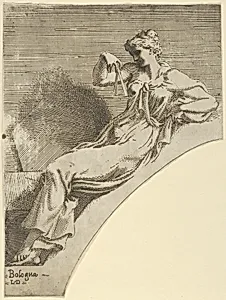
Erato, from "Twelve Muses and Goddesses"
ca. 1540–45
Medium
Etching
Dimensions
Sheet (trimmed): 9 1/16 × 6 7/8 in. (23 × 17.4 cm)
Classification
Prints
Department
Drawings and Prints
Museum
Metropolitan Museum of Art, New York, NY
Credit
The Elisha Whittelsey Collection, The Elisha Whittelsey Fund, 1949
Accession Number
49.97.556
Rights
Public Domain
Tags
Art Historical Context
In the elegant etching *Erato, from "Twelve Muses and Goddess"* (ca. 1540–45), French engraver Léon Davent brings to life a design by Italian Mannerist artist Francesco Primatic. Erato, the Muse of poetry and love, is depicted with her characteristic lyre, embodying the classical ideal of inspiration and harmony. This intimate sheet, measuring just 9 1/16 × 6 7/8 inches, captures the graceful, elongated figures typical of Mannerism, blending Italian sophistication with French royal patronage. Created during the reign of King Francis I at the Château de Fontainebleau, the work reflects the cultural exchange between Italy and France in the mid-16th century. Primaticcio, a key figure in the School of Fontainebleau, supplied inventive compositions that Davent translated into precise etchings—a relatively new printmaking technique at the time, prized for its fluid lines and tonal subtlety. This series of twelve mythological women popularized antique themes among Europe's elite, making classical learning accessible through affordable prints. Housed in the Metropolitan Museum of Art's Elisha Whittelsey Collection, *Erato* highlights the Renaissance revival of Greek muses as symbols of artistic patronage. Visitors will appreciate its delicate craftsmanship, a window into how mythology fueled the creative spirit of the era.
About the Artist
Léon Davent|Francesco Primaticcio · 1540–1556
**Léon Davent** (also known as Master L.D. or the monogrammist L.D.) was a French printmaker active in the mid-16th century, best known for his work in both engraving and etching. He played a leading role in the printmaking workshop associated with the First School of Fontainebleau at the Palace of Fontainebleau during the 1540s. His prints, often signed simply “L.D.,” reproduced designs by Italia...