
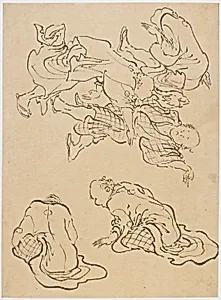
Men dancing, and miscellaneous figures
1760-1849
Classification
Painting
Department
Smithsonian Collection
Museum
Smithsonian American Art Museum
Credit
Gift of Charles Lang Freer
Accession Number
F1904.231
Rights
Public Domain
Tags
About this artwork
To 1904
Art Historical Context
Katsushika Hokus (1760–1849), one of Japan's most celebrated artists, created *Men Dancing, and Miscellaneous Figures* the vibrant Edo period (1615–8). This painting captures the lively spirit of everyday Japanese life, a hallmark of Hokusai ukiyo-e ("pictures of the floating world"), which often celebrated fleeting pleasures like theater, festivals, and dance. Though best known for woodblock prints such as *The Great Wave Kanagawa*, Hai was a master painter whose works blended dynamic compositions with keen observation of human movement. The scene depicts men in exuberant dance amid miscellaneous figures, evoking the cultural fervor of Edo-era entertainment—possibly inspired by kabuki performances or street celebrations. Hokusai's fluid lines and expressive poses highlight the rhythmic energy of traditional Japanese dance, reflecting societal values of harmony and transience. As a painting from his prolific career spanning nearly 90 years, it showcases his innovative techniques in capturing motion and emotion. Generously gifted to the Smithsonian American Art Museum by collector Charles Lang Freer, this piece joins his renowned collection of Asian art, acquired before 1904. Visitors will appreciate how it bridges Hokusai's printmaking genius with intimate painted narratives, offering a window into Japan's artistic golden age.