
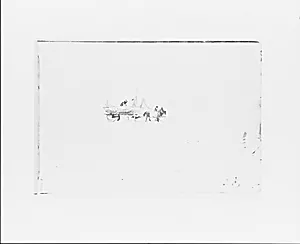
Men with a Hayrick drawn by Two Horses (from Sketchbook VII)
Medium
Graphite on off-white wove paper
Dimensions
5 x 7 1/2 in. (12.7 x 19.1 cm)
Classification
Drawing
Culture
American
Department
The American Wing
Museum
Metropolitan Museum of Art, New York, NY
Credit
Purchase, Gifts in memory of Stephen D. Rubin, 1992
Accession Number
1992.2.1f recto
Rights
Public Domain
Tags
Art Historical Context
In the tranquil galleries of The American Wing at the Metropolitan Museum of Art visitors encounter *Men with a Hayrick drawn by Horses* from William Trost Richards'Sketchbook VII* (1886). This modest graphite drawing on off-white wove paper measuring just 5 x 7½ inches (12.7 x 19.1 cm), captures an everyday rural vignette: sturdy horses pulling a hay-laden cart, guided by two men. Acquired in 1992 through purchase with gifts in memory of Stephen D. Rubin, it exemplifies the intimate scale of an artist's personal sketchbook. William Trost Richards, a leading American artist of the 19th century, was celebrated for his meticulous naturalism, often linked to the Hudson River School's emphasis on America's landscapes. Here, his graphite technique shines through fine lines and subtle shading, rendering the animals' musculature, the hayrick's texture, and human figures with lifelike precision. Such sketches served as studies for larger works, blending observation with artistic economy. Dating to 1886, this piece reflects late Gilded Age rural life, evoking the harmony of labor and nature in an era of agricultural transition. Its cultural resonance lies in preserving fleeting moments of American heritage, inviting us to appreciate the quiet poetry in the ordinary.
About the Artist
William Trost Richards · 1833–1905
William Trost Richards (1833–1905) was a prominent American landscape and marine painter born in Philadelphia, where he attended Central High School before beginning his artistic training. Between 1850 and 1855, he studied part-time under the German-born Hudson River School artist Paul Weber while working as a designer and illustrator of ornamental metalwork. He exhibited his first works at the Pe...