
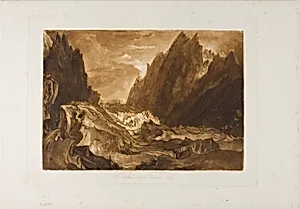
Mer de Glace, plate 50 from Liber Studiorum
published May 23, 1812
Medium
Etching and engraving in brown on ivory laid paper
Dimensions
Image: 18 × 25.8 cm (7 1/8 × 10 3/16 in.); Plate: 22 × 29.5 cm (8 11/16 × 11 5/8 in.); Sheet: 26.6 × 38.2 cm (10 1/2 × 15 1/16 in.)
Classification
etching
Department
Prints and Drawings
Museum
Art Institute of Chicago
Accession Number
50147
Rights
Public Domain
Art Historical Context
**Mer de Glace, 50 from *Liber Studiorum***Joseph Mallord William Turner, visionary British Romantic artist, captured the sublime majesty of the Alps in this striking print, published on May 23, 1812. As plate 50 from his ambitious *Liber Studiorum* (1807–1819), it belongs to the "Mountainous category, showcasing Turner's profound fascination with nature's raw power. Inspired by 17th-century master Claude Lorrain, series of 71 prints demonstrated Turner's versatility across landscape genres, blending observation with imaginative drama. "Mer de Glace," meaning "Sea of Ice," evokes the vast Mer de Glace glacier near Chamonix, a site that captivated early 19th-century travelers during the Romantic era's embrace of the picturesque and the awe-inspiring. Printed in brown ink on creamy ivory laid paper via etching and engraving, this work highlights Turner's technical mastery. Etching allowed fluid, expressive lines for the jagged ice and swirling mist, while engraving added precise tonal depth, creating a moody, atmospheric glow that contrasts the cold glacier with warm earth tones. Measuring about 18 × 25.8 cm, its intimate scale invites close contemplation, much like a sketchbook study come to life. Housed in the Art Institute of Chicago's Prints and Drawings Department, this etching exemplifies Turner's influence on modern landscape art, bridging painting and printmaking. It reflects the era's growing interest in alpine exploration, offering visitors a window into Romanticism's celebration of nature's grandeur.
About the Artist
Joseph Mallord William Turner · 1775–1851
Joseph Mallord William Turner, born on 23 April 1775 in London's Covent Garden to barber William Turner and Mary Marshall, emerged as a child prodigy amid personal hardships. His mother suffered mental illness and died in Bethlem Hospital in 1804, while his father supported his early sketches by displaying them in his shop. Around age 10, Turner stayed with his uncle Joseph Mallord William Marshal...