
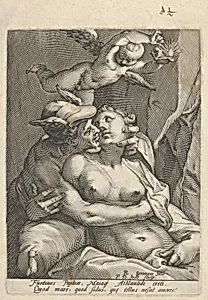
Mercury Embracing Venus
Medium
Engraving
Dimensions
Plate: 6 3/4 × 4 15/16 in. (17.2 × 12.6 cm) Sheet: 11 7/16 × 7 11/16 in. (29.1 × 19.6 cm)
Classification
Prints
Department
Drawings and Prints
Museum
Metropolitan Museum of Art, New York, NY
Credit
The Elisha Whittelsey Collection, The Elisha Whittelsey Fund, 1956
Accession Number
56.597.13
Rights
Public Domain
Tags
Art Historical Context
This engraving captures the intimate embrace of Mercury, the swift messenger of the gods, and Venus, the goddess of love, rendered with the graceful elegance characteristic of Northern Mannerism. Created between 1588 and 1634 by engraver Pieter de Jode I after a design by Bartholomeus Spranger, the print translates the fluid, elongated figures and dynamic poses typical of Spranger’s paintings into a precise black-and-white medium. Spranger, a Flemish artist active at the court of Emperor Rudolf II in Prague, infused classical mythology with sensual sophistication, and de Jode’s skilled burin work preserves these qualities for wider audiences. Engravings like this played a vital role in the late Renaissance and early Baroque periods by disseminating sophisticated mythological imagery across Europe. Collectors and artists could study the composition’s refined contours and subtle modeling without traveling to see the original painting. The compact plate size—roughly the dimensions of a small book page—made the work both intimate and portable, inviting close contemplation of the gods’ tender interaction. Housed in the Metropolitan Museum of Art’s Department of Drawings and Prints, the sheet exemplifies how reproductive engravings bridged painting and printmaking, extending the reach of courtly Mannerist ideals to a broader public.