
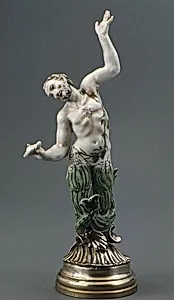
Merman (one of six)
1750–55
Medium
Hard-paste porcelain, silver
Dimensions
Height: 7 7/8 in. (20 cm)
Classification
Ceramics-Porcelain
Culture
Italian, Florence
Department
European Sculpture and Decorative Arts
Museum
Metropolitan Museum of Art, New York, NY
Credit
Purchase, The Charles E. Sampson Memorial Fund and Gift of Mrs. Harold D. Shattuck, by exchange, 1982
Accession Number
1982.6.2
Rights
Public Domain
Tags
Art Historical Context
Crafted by the renowned Doccia Porcelain Manuf in Florence, Italy, around 1750–55, *Merman (one of six)* exemplifies the height of 18th-century European porcelain artistry. This petite hard-paste porcelain figure, standing just 7⅞ inches tall and enhanced with silver accents, depicts a mythical merman—half-man, half-fishfrozen in dynamic motion. Produced during the Rococo era, when opulent decorative objects graced the tables and cabinets of Europe's aristocracy, it was one of a matching set of six, likely intended as a luxurious garniture for mantelpieces or dining displays. Doccia, founded in 1735 by Marchese Carlo Ginori near Florence, was a pioneer in Italy for mastering hard-paste porcelain, a technically demanding medium fired at high temperatures to achieve its signature translucency, strength, and white purity—rivaling the finest Chinese imports and German Meissen wares. The manufactory's sculptors excelled in intricate modeling, capturing the merman's muscular form, flowing hair, and scaly tail with lifelike detail, often heightened by subtle gilding or polychrome enamels. These whimsical sea creatures drew from classical mythology and Baroque fantasies, symbolizing the wonders of the deep and the era's fascination with the exotic. Today, at The Metropolitan Museum of Art, this rare survivor highlights Doccia's role in elevating Italian ceramics to international acclaim, blending technical innovation with playful elegance for collectors worldwide.
About the Artist
Doccia Porcelain Manufactory · 1737–1896
The Doccia Porcelain Manufactory, founded in 1737 by Marquis Carlo Ginori near Florence, holds the distinction of being Italy's first hard-paste porcelain manufacturer and one of the few European porcelain enterprises to survive from the eighteenth century to the present day without interruption. Unlike most contemporary ventures — which depended on the patronage and protection of ruling courts — ...