
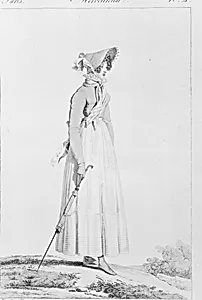
Merveilleuse: Chapeau à l’Anglaise, Spencer à l’Anglaise
Medium
Hand colored engraving
Dimensions
Sheet: 16 3/16 × 10 11/16 in. (41.1 × 27.1 cm) Plate: 14 9/16 × 9 1/2 in. (37 × 24.1 cm) Album: 16 3/4 × 11 5/8 × 11/16 in. (42.5 × 29.5 × 1.7 cm)
Classification
Books|Prints|Ornament & Architecture
Department
Drawings and Prints
Museum
Metropolitan Museum of Art, New York, NY
Credit
Harris Brisbane Dick Fund, 1924
Accession Number
24.18(21)
Rights
Public Domain
Tags
Art Historical Context
In 1814, amid the Bourbon Restoration following Napoleon's abdication, French fashion enthusiasts embraced this hand-colored engraving titled *Merveilleuse: Chapeau à l’Anglaise, Spencer à l’Anglaise*. Created by painter Horace Vernet and engraver Georges Jacques Gatine it exemplifies the vibrant fashion plates that popularized high-style trends among Europe's elite women. The "Merveilleuse"—a nod to the glamorous, neoclassical beauties of the late 1790s Directory period—here sports an "English hat" (a wide-brimmed chapeau à l’anglaise) and a tailored spencer jacket, reflecting Anglo-inspired simplicity and elegance that contrasted with the opulent Empire silhouette. Hand-coloring elevated these engravings from mere illustrations to coveted collectibles, with delicate washes of watercolor adding lifelike vibrancy to fabrics and feathers. Produced on a modest sheet (16 3/16 × 10 11/16 in.), this print from the Metropolitan Museum of Art's Drawings and Prints department captures the era's cultural shift: English influences symbolized post-Revolutionary restraint and emerging Romanticism in women's attire. These plates were more than art—they were trendsetters, disseminated via albums to mantua-makers and magazines, shaping wardrobes across social classes and bridging art with everyday aspiration. A charming window into Regency-era glamour!
About the Artist
Horace Vernet|Georges Jacques Gatine · 1789–1863
**Horace Vernet** (full name Émile Jean-Horace Vernet) was a leading French painter of the nineteenth century, renowned for his dynamic battle scenes, portraits, and Orientalist subjects. Born on 30 June 1789 in Paris at the Louvre during the French Revolution, he came from a distinguished artistic dynasty. He was the son of the equestrian and military painter Carle Vernet and the grandson of the ...