
Metal Keyplate for Church
second half 19th century
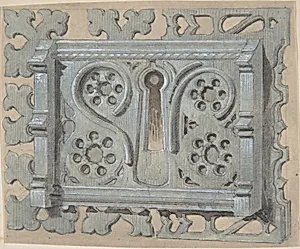
Medium
Gouache
Dimensions
plate: 3 3/4 x 4 9/16 in. (9.5 x 11.6 cm)
Classification
Drawings|Ornament & Architecture
Department
Drawings and Prints
Museum
Metropolitan Museum of Art, New York, NY
Credit
The Elisha Whittelsey Collection, The Elisha Whittelsey Fund, 1960
Accession Number
60.632.148(2)
Rights
Public Domain
Art Historical Context
This delicate gouache drawing, titledMetal Keyplate for Church*, captures the refined artistry of anonymous British craftsmen from the second half of 19th century. just 3 3/4 x 4 9/16 inches, it depicts an ornate metal keyplate intended for ecclesiastical use, blending functionality with decorative elegance. Housed in the Metropolitan Museum of Art's of Drawings and Prints as part of The Elisha Whittelsey Collection (acquired in 1960), it exemplifies the period's fascination with architectural ornamentation. Created in gouache—an opaque watercolor medium prized for its vibrant colors and smooth finish—this work served as a precise design template for metalworkers. Gouache allowed artists to render fine details like intricate filigree, floral motifs, and Gothic-inspired flourishes with jewel-like precision, bridging the gap between sketch and finished object. In Victorian Britain, such drawings were essential for church renovations amid the Gothic Revival, where even humble hardware like keyplates became symbols of spiritual devotion and craftsmanship. Though anonymous, the creator's skill highlights the collaborative world of 19th-century design, where draftsmen elevated everyday elements into art. Visitors will appreciate how this small gem reveals the hidden artistry behind grand ecclesiastical spaces.
About the Artist
Anonymous, British, 19th century · 1800–1900
**Anonymous, British, 19th century** is not the name of a single individual but a standard museum attribution used for works whose creators remain unidentified yet are clearly British and date to the 1800s. Major institutions, including the Metropolitan Museum of Art, employ this designation for hundreds of drawings, prints, designs, and decorative studies that lack signatures or firm documentary ...