
Metallic Double Cobweb Valentine
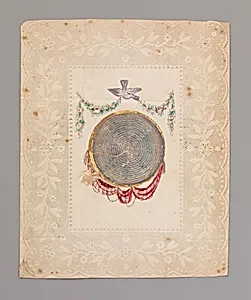
Medium
Lithography, watercolor, metallic paper on embossed paper
Dimensions
Sheet: 9 1/16 × 7 5/16 in. (23 × 18.5 cm)
Classification
Ephemera|Prints
Department
Drawings and Prints
Museum
Metropolitan Museum of Art, New York, NY
Credit
Gift of Mrs. Richard Riddell, 1981
Accession Number
1981.1136.547
Rights
Public Domain
Tags
Art Historical Context
Step into the whimsical world of Victorian romance with *Metallic Double Cobweb Valentine*, an enchanting 1845 print from anonymous British hands. Created during the peak of Valentine's Day fervor in 19th-century Britain, ephemera captures the era's obsession with sentimental greetings. Mass-produced yet delicately personalized, such cards flooded postboxes as literacy rose and printing innovations made affection affordable for sweethearts across classes. Measuring a dainty 9 1/16 × 7 5/16 inches, it likely features ethereal girls and fairies—evoked by its tags—dancing amid intricate, web-like motifs symbolizing love's delicate snare. The artwork shines through masterful techniques: lithography for precise reproduction of fine patterns, layered with watercolor for soft hues, metallic paper for a sparkling allure, and embossed paper for tactile depth. This "double cobweb" design, with its duplicated lacy layers, exemplifies the opulent "cobweb valentine" style, mimicking handmade cut-paper lace but scaled for the masses. Such innovations democratized beauty, blending industrial precision with artisanal charm. Housed in the Metropolitan Museum of Art's Drawings and Prints department (gift of Mrs. Richard Riddell, 1981), this piece whispers of courtship rituals now faded, reminding us how 19th-century Brits wove fantasy into fleeting tokens of the heart. A sparkling survivor of ephemeral love!
About the Artist
Anonymous, British, 19th century · 1800–1900
**Anonymous, British, 19th century** is not the name of a single individual but a standard museum attribution used for works whose creators remain unidentified yet are clearly British and date to the 1800s. Major institutions, including the Metropolitan Museum of Art, employ this designation for hundreds of drawings, prints, designs, and decorative studies that lack signatures or firm documentary ...