
Valentine
1830–50
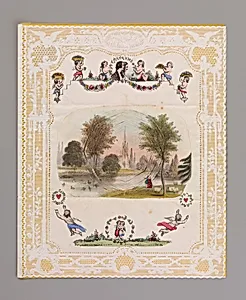
Medium
Lithography, watercolor, open-work cameo-embossed paper
Dimensions
Sheet: 9 3/8 × 7 13/16 in. (23.8 × 19.8 cm)
Classification
Ephemera|Prints
Department
Drawings and Prints
Museum
Metropolitan Museum of Art, New York, NY
Credit
Gift of Mrs. Richard Riddell, 1981
Accession Number
1981.1136.533
Rights
Public Domain
Tags
Art Historical Context
This charming Valentine, created anonymously between 1830 and 1850, captures the sentimental spirit of early 19th-century romance a delicate print featuring children, playful Cupids, and idyllic landscapes. Produced as ephemera—a category of short-lived printed matter like greeting cards—it exemplifies the rising popularity of mass-produced valentines during the era, when exchanging such tokens became a widespread custom in Europe and America, blending affection with whimsy. The artwork's medium is a highlight: lithography allowed for detailed, reproducible imagery, enhanced by hand-applied watercolor for vibrant hues and open-work cameo-embossed paper that creates intricate cut-out designs and raised relief, giving it a luxurious, three-dimensional texture. At 9 3/8 × 7 13/16 inches, this sheet from the Metropolitan Museum of Art's Drawings and Prints department showcases affordable artistry that mimicked fine craftsmanship, making romance accessible to the middle class. Preserved through the gift of Mrs. Richard Riddell in 1981, this piece offers a window into everyday cultural rituals, revealing how Cupid's arrows and pastoral scenes symbolized enduring love in a rapidly industrializing world. A delightful survivor of fleeting festivities, it reminds us of art's power in the intimate moments of life.
About the Artist
Anonymous
In the vast tapestry of art history, "Anonymous" stands not as a singular individual but as a collective designation for countless unidentified creators whose works have endured across millennia. These artists, spanning prehistoric cave painters to medieval illuminators and folk craftsmen, produced the foundational layers of human visual culture. Prior to the Renaissance, when individual fame emer...