
Michelangelo Buonarroti
1911
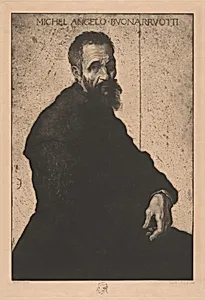
Medium
etching and aquatint on buff Japanese paper
Dimensions
image: 57.79 × 39.37 cm (22 3/4 × 15 1/2 in.) sheet: 79.69 × 57.15 cm (31 3/8 × 22 1/2 in.)
Classification
Department
CG-E
Museum
National Gallery of Art, Washington, D.C.
Credit
Purchased in Memory of Lionel C. Epstein
Accession Number
2019.65.3
Rights
Public Domain
Art Historical Context
In 1911, Austrian artist Emil Orlik created this striking etching and aquatint titled *angelo Buonarroti*, homage to the Renaissance genius known for masterpieces like the Sistine Chapel and David. Orlik, a master printmaker associated with the Vienna Secession movement, captured Michelangelo's intense visage with remarkable depth and expressiveness. Printed on buff Japanese paper—a nod to Orlik's fascination with uyo-e woodblock techniques—the image measures 57.79 × 39.37 cm, with a larger sheet of 7969 × 57.15 cm, allowing for generous margins that enhance its intimate scale. Etching provides crisp lines for Michelangelo's features, while aquatint adds velvety tonal gradations, mimicking the subtlety of painting in a print medium. Orlik's innovative blend of Western intaglio and Eastern paper traditions reflects early 20th-century cross-cultural exchanges in European art, bridging Renaissance heroism with modernist graphic experimentation. Acquired by the National Gallery of Art in memory of Lionel C. Epstein, this print celebrates not just its subject but Orlik's legacy in elevating printmaking to fine art. Visitors will appreciate its tactile richness and timeless tribute to creative endurance.
About the Artist
Emil Orlik · 1870–1932
Emil Orlík (1870–1932) was a Czech painter, etcher, and lithographer whose cosmopolitan career bridged the artistic centers of Prague, Vienna, Munich, Berlin, and Tokyo. Born on July 21, 1870, in Prague, Orlík became one of the most important promoters of Japanese art and woodcut techniques in early twentieth-century Europe, directly studying traditional Japanese printmaking methods during two ext...