
Military Parade
1801 to 1825
Medium
pen and brown ink with gray wash over graphite
Dimensions
overall: 17.5 x 25.5 cm (6 7/8 x 10 1/16 in.)
Classification
Drawing
Department
CG-E
Museum
National Gallery of Art, Washington, D.C.
Credit
Collection of Mr. and Mrs. Paul Mellon
Accession Number
1985.64.93
Rights
Public Domain
Art Historical Context
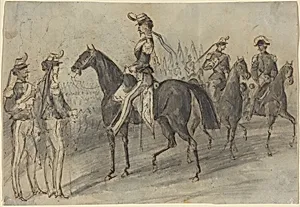
Constantin Guys, a pioneering 19th-century French artist celebrated by Charles Baudelaire as the "painter of modern life," captures the energy of early 19th-century Europe in *Military Parade* (ca. 1801–1825). Created during Guys' formative years—possibly amid the Napoleonic Wars' aftermath—this intimate drawing depicts soldiers in formation, evoking the pomp and discipline of the era's military culture. At just 17.5 x 25.5 cm, it reflects Guys' role as a visual correspondent, sketching scenes from his own military service and travels. Executed in pen and brown ink with gray wash over graphite, the work showcases Guys' masterful technique for rapid, expressive reportage. The graphite underdrawing provides fluid contours, while the ink lines and subtle wash add depth and movement, foreshadowing impressionism and modern illustration. Housed in the National Gallery of Art's Collection of Mr. and Mrs. Paul Mellon, this drawing highlights Guys' skill in distilling fleeting public spectacles into enduring art, offering visitors a window into a time when military parades symbolized national pride and social spectacle.
About the Artist
Constantin Guys · 1802–1892
Constantin Guys, born Ernest-Adolphe-Hyacinthe-Constantin Guys de Saint-Hélène on December 3, 1802, in Vlissingen, Netherlands, to French parents François Lazare Guys and Elisabeth Bétin, spent his early years in a naval family that relocated to Calais around 1805. His early life is not well documented, with no records of formal art training, teachers, or schools; Guys appears to have been largely...