
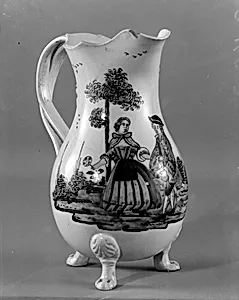
Milk pitcher
Unknown Artist
1770–80
Medium
Earthenware
Dimensions
H. 5 1/8 in. (13 cm)
Classification
Milk pitcher
Culture
British
Department
The American Wing
Museum
Metropolitan Museum of Art, New York, NY
Credit
Harris Brisbane Dick Fund, 1938
Accession Number
38.165.3
Rights
Public Domain
Tags
Art Historical Context
This delicate earthenware milk pitcher, crafted in Britain between 1770 and 1780, exemplifies the everyday elegance of 18th-century domestic ceramics. Standing just 5⅛ inches (13 cm) tall, its modest scale made it ideal for household use, likely gracing breakfast tables to pour fresh milk for families. The unknown artisan employed earthenware—a porous, low-fired clay body common in British pottery production—often coated with a tin-glazed or slip decoration to enhance durability and appeal. Produced during the height of the Industrial Revolution's early stirrings, such pitchers highlight Britain's dominance in exporting affordable ceramics to Europe and the American colonies. Displayed in The Metropolitan Museum of Art's American Wing, it reflects transatlantic trade and colonial tastes, where British wares furnished homes amid growing independence sentiments. Decorative motifs possibly featuring men and women evoke the social scenes of the era, blending utility with subtle narrative charm. As a survivor of daily life, this pitcher offers a tangible glimpse into Georgian-era routines, underscoring earthenware's role in democratizing fine design for ordinary folk. Its acquisition via the Harris Brisbane Dick Fund in 1938 preserves a slice of material history for modern visitors.