
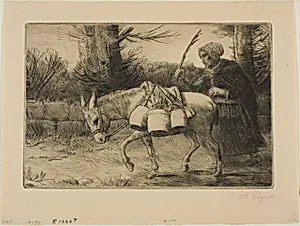
Milkmaid
c. 1880
Medium
Etching and drypoint on buff laid paper
Dimensions
Image/plate: 14.9 × 22.3 cm (5 7/8 × 8 13/16 in.); Sheet: 20 × 26.3 cm (7 7/8 × 10 3/8 in.)
Classification
etching
Department
Prints and Drawings
Museum
Art Institute of Chicago
Accession Number
14850
Rights
Public Domain
Art Historical Context
**Milkmaid** by Alphonse Legros created around 1880, captures the quiet dignity of rural life through the image of a milkmaid at work. Legros, a French-born who spent much of his career in, was a leading figure in the 19th-century revival of printmaking. Influenced by Realism, his works often celebrated everyday peasant scenes, blending meticulous observation with a poetic simplicity that echoes the Dutch masters like Rembrandt, whom he greatly admired. This etching and drypoint on buff laid paper exemplifies Legros's technical prowess. Etching involves incising lines into a metal plate with acid for crisp precision, while drypoint adds velvety burrs from direct needle scratches, creating rich tonal depth and texture. The modest dimensions—image at 14.9 × 22.3 cm—highlight the intimacy of printmaking, allowing for multiple impressions that democratized art access during the era. Housed in the Art Institute of Chicago's Prints and Drawings Department, **Milkmaid** reflects the cultural shift toward valuing labor and nature amid industrialization. Legros's innovative techniques helped elevate etching as a fine art, bridging 17th-century traditions with modern sensibilities, inviting viewers to savor the subtle beauty in ordinary moments.
About the Artist
Alphonse Legros · 1837–1911
Alphonse Legros (1837–1911) was born in Dijon, France, and trained in Paris at the drawing school of Horace Lecoq de Boisbaudran, whose unconventional teaching method — which emphasised memory drawing and acute observation over academic convention — would leave a lasting mark on Legros's practice. At Lecoq's school he formed friendships with Jules Dalou and Auguste Rodin that endured throughout hi...