
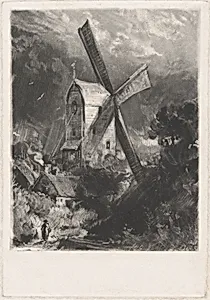
Mill Near Brighton
Medium
Mezzotint; proof before published state
Dimensions
Image: 5 3/4 × 4 1/2 in. (14.6 × 11.4 cm) Plate: 7 1/16 × 4 13/16 in. (17.9 × 12.2 cm) Sheet: 17 9/16 × 11 7/8 in. (44.6 × 30.2 cm)
Classification
Prints
Department
Drawings and Prints
Museum
Metropolitan Museum of Art, New York, NY
Credit
Harris Brisbane Dick Fund, 1938
Accession Number
38.23.2
Rights
Public Domain
Tags
Art Historical Context
"Mill Near Brighton" (1829) is a captivating mezzotint proof created through the collaboration of two British masters: painter John Constable and engraver David Lucas. Constable, a leading Romantic artist renowned for his luminous depictions of the English countryside, provided the original composition, while Lucas meticulously translated it into print. This proof, an early state before the final published version captures a quaint windmill near the Sussex coast, evoking the serene rural life that Constable cherished amid the encroaching Industrial Revolution. Mezzotint, Lucas's specialty, revolutionized printmaking with its ability to produce deep, velvety blacks and subtle tonal gradations—ideal for Constable's atmospheric effects of light and shadow. Unlike crisp line engravings, this "painterly" technique allowed the image's soft textures and moody skies to shine, making high-quality reproductions accessible to a wider audience. Produced as part of Constable's "English Landscape Scenery" series, it exemplifies early 19th-century efforts to democratize art. Housed in the Metropolitan Museum of Art, this proof offers a rare glimpse into the artistic process, highlighting windmills as symbols of England's pastoral heritage. Visitors will appreciate how it bridges painting and print, preserving Constable's vision of unspoiled nature for generations.
About the Artist
David Lucas|John Constable · 1802–1881
**David Lucas (1802–1881)** David Lucas was born in 1802 in Geddington Chase, Northamptonshire, the son of a farmer.) A chance encounter in 1820 led him to become a pupil of the renowned engraver Samuel William Reynolds, under whom he apprenticed in London until 1827, mastering the art of mezzotint engraving.) By 1827, Lucas had published his first mezzotints, showcasing his precocious talent for...