
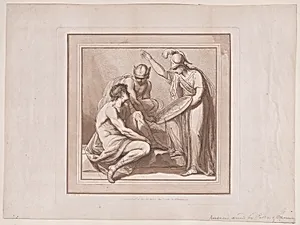
Minerva and Mercury
Medium
Etching and aquatint, printed in brown ink; second state
Dimensions
Sheet: 12 1/2 × 16 3/4 in. (31.8 × 42.5 cm) Plate: 10 1/4 × 10 5/8 in. (26 × 27 cm)
Classification
Prints
Department
Drawings and Prints
Museum
Metropolitan Museum of Art, New York, NY
Credit
Gift of Edward W. Root, Elihu Root Jr. and Mrs. Ulysses S. Grant III, 1937
Accession Number
37.17.40
Rights
Public Domain
Art Historical Context
**Minerva and Mercury**1787) is a captivating print created through a collaboration of Italian artists Domenico Marchetti, Giovanni Battista Cipani, and Francesco Bartozzi, exemplifying the neoclassical revival of antiquity in late 18th-century Europe. Cipriani, known for his elegant drawings inspired by classical mythology, likely designed the composition, while Bartolozzi—a master engraver—and Marchetti executed the etching and aquat in brown ink. This second-state impression, refined for greater detail, measures a modest plate size of 10¼ × 10⅝ inches, making it an accessible luxury for collectors. The artwork depicts Minerva, the Roman goddess of wisdom and strategic warfare (equivalent to Greek Athena), alongside Mercury, the swift messenger god of commerce and travel (Hermes). Such pairings symbolized intellect guiding communication and ingenuity, resonating with Enlightenment ideals of reason and progress. Printed on a larger sheet (12½ × 16¾ inches), it reflects the era's fascination with Greco-Roman myths, popularized through grand history paintings and reproductive prints. Etching provided precise lines for the figures' flowing drapery and dynamic poses, while aquatint added tonal depth and subtle shading, techniques Bartolozzi helped innovate for richer, painterly effects in printmaking. Donated to the Metropolitan Museum of Art in 1937 by Edward W. Root, Elihu Root Jr., and Mrs. Ulysses S. Grant III, this piece highlights how prints democratized high art, bridging ancient lore with modern audiences.