
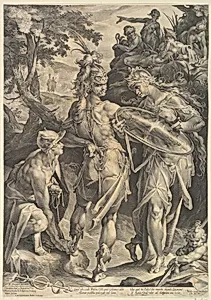
Minerva and Mercury Arming Perseus
Medium
Engraving; New Holl.'s third state of three
Dimensions
Sheet: 22 1/4 × 15 11/16 in. (56.5 × 39.8 cm)
Classification
Prints
Department
Drawings and Prints
Museum
Metropolitan Museum of Art, New York, NY
Credit
The Elisha Whittelsey Collection, The Elisha Whittelsey Fund, 1949
Accession Number
49.95.2283
Rights
Public Domain
Tags
Art Historical Context
Behold *Minerva and Mercury Arm Perseus* (1604), a engraving that captures a pivotal moment from classical mythology. In this dynamic scene, the gods Minerva (Athena) Mercury (Hermes) equip the hero Perseus for his perilous quests—slaying Medusa and rescuing Andromeda—as recounted in Ovid's *Metoses*. Designed by the Flemish Mannerist painter Bartholomeusanger, known for his elegant, elongated figures and courtly grace while serving Emperor Rudolf II in Prague, the print was expertly engraved by Jan Muller and Harmen Jansz. Muller. Measuring an impressive 22¼ × 15⅝ inches, this third state (per New Hollstein's catalog) exemplifies the collaborative artistry of the Northern Renaissance. Spranger's Mannerist style shines through in the print's sinuous lines and idealized nude forms, blending Italian influences with Northern precision. Engravings like this were revolutionary reproductive prints, allowing Spranger's luxurious compositions—originally paintings for elite patrons—to reach a wider audience across Europe. The intricate burin work by the Mullers captures shimmering armor, flowing drapery, and divine poise with remarkable fidelity. Housed in the Metropolitan Museum of Art's Drawings and Prints department (Elisha Whittelsey Collection, 1949), this work highlights the era's fascination with mythology and humanism. It invites visitors to marvel at how printmaking democratized high art, bridging imperial courts and curious collectors.