
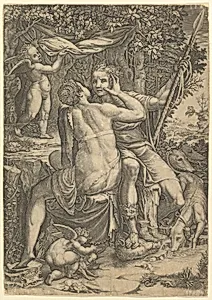
Venus and Adonis
ca. 1570
Medium
Engraving
Dimensions
sheet: 12 7/16 x 8 3/4 in. (31.6 x 22.2 cm) borderline
Classification
Prints
Department
Drawings and Prints
Museum
Metropolitan Museum of Art, New York, NY
Credit
Harris Brisbane Dick Fund, 1947
Accession Number
47.100.711
Rights
Public Domain
Tags
Art Historical Context
Behold *Venus and Adonis*, captivating engraving from around 1570 by the skilled Italian brothers Giorgio and Teodoro Ghisi. This print captures a pivotal moment from classical mythology, drawn from Ovid's *Metoses*: the goddess Venus tenderly embraces her mortal lover Adonis, surrounded by hunting dogs and spears that foreshadow his tragic death by a wild boar. The Ghisi brothers, renowned Mannerist engravers, masterfully reproduced such scenes, often after paintings by masters like Titian, making elite art accessible to a wider audience during the Renaissance. Crafted on a sheet measuring 12 7/16 x 8 3/4 inches, this engraving exemplifies the precision of intaglio printing. Fine, intricate lines create depth, texture, and dramatic chiaroscuro, highlighting Venus's flowing drapery, Adonis's muscular form, and the alert dogs—elements that evoke tension between love and peril. As part of the Metropolitan Museum of Art's Drawings and Prints collection (acquired via the Harris Brisbane Dick Fund in 1947), it showcases the era's technical innovation, where engravings bridged painting and printmaking. This work reflects 16th-century fascination with sensual mythology, blending eroticism and melancholy to explore human fragility. A testament to the Ghisis' legacy, it invites visitors to ponder timeless themes of passion's fleeting beauty.
About the Artist
Giorgio Ghisi|Teodoro Ghisi · 1520–1582
Giorgio Ghisi (c. 1520–1582) was one of the most accomplished engravers of the Italian Renaissance, renowned for translating the monumental compositions of Raphael, Giulio Romano, and Michelangelo into the exacting medium of the burin. Born in Mantua, he trained in an environment shaped by the legacy of Giulio Romano's decoration of the Palazzo del Te, and the grandeur of that Mannerist tradition ...