
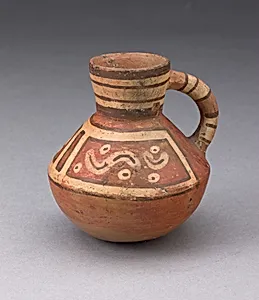
Miniature Handled Bottle with Abstract Motifs
600–1000
Medium
Ceramic and pigment
Dimensions
7.6 × 7.3 cm (3 × 2 7/8 in.)
Classification
earthenware
Department
Arts of the Americas
Museum
Art Institute of Chicago
Accession Number
90879
Rights
Public Domain
Art Historical Context
This exquisite miniature handled bottle hails from the Tiwanaku culture, a thriving Andean civilization centered near Lake Titicaca in present-day Bolivia from around 600 to 1000 CE. Crafted from earthenware and adorned with pigments, it measures just 7.6 × 7.3 cm, making it a pocket-sized treasure that speaks volumes about the ingenuity of pre-Inca artisans. Tiwanaku society was renowned for its monumental stone architecture and sophisticated crafts, and ceramics like this one were essential to daily life, rituals, and exchanges. The bottle's abstract motifs, painted in vibrant pigments over a polished surface, exemplify Tiwanaku's distinctive style—geometric patterns and stylized forms that may evoke mythological themes or symbolic cosmology. Handles suggest practical use for pouring liquids, perhaps chicha (fermented corn beer) in ceremonies, while the miniature scale hints at its role as a votive offering or prestige item. Techniques like slip decoration and firing created durable, glossy finishes that have endured for over a millennium. Housed in the Art Institute of Chicago's Arts of the Americas collection, this vessel offers a window into Tiwanaku's artistic legacy, bridging utility and spirituality in one of South America's most influential ancient cultures.