
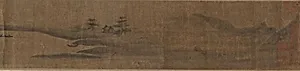
明/清 佚名 仿方從義 巢雲圖 卷|Miniature Landscape
Medium
Two handscrolls; ink on paper
Dimensions
Image (a): 3 5/8 × 46 in. (9.2 × 116.8 cm) Image (b): 3 7/8 × 35 in. (9.8 × 88.9 cm)
Classification
Paintings
Culture & Period
China · Ming (1368–1644) or Qing dynasty (1644–1911)
Department
Asian Art
Museum
Metropolitan Museum of Art, New York, NY
Credit
From the Collection of A. W. Bahr, Purchase, Fletcher Fund, 1947
Accession Number
47.18.13a, b
Rights
Public Domain
Tags
Art Historical Context
This exquisite pair of handscrolls, titled *Miniature Landscape* (or *Nesting Clouds*), was created by an unidentified Chinese artist during the Ming (1368–1644) or Qing dynasty (1644–1911). Executed in ink on paper, the works measure just a few inches in height, making them unusually intimate examples of the traditional handscroll format. Designed to be viewed section by section in the palm of the hand, these miniature scrolls invite a quiet, personal engagement with the misty mountain scenes they depict. The paintings are explicitly presented as an imitation of Fang Congyi, a Yuan-dynasty master celebrated for his ethereal, cloud-filled landscapes. By copying and reinterpreting an earlier artist’s style, the anonymous painter participates in a long-standing Chinese tradition of artistic homage and creative transmission. The delicate ink washes and abbreviated forms also echo the spare, atmospheric approach associated with Song-dynasty masters such as Xia Gui, demonstrating how later artists continually looked back to earlier models. Acquired by the Metropolitan Museum of Art in 1947 from the renowned collection of A. W. Bahr, these scrolls highlight the enduring appeal of Chinese landscape painting as a vehicle for contemplation and cultural memory. Their small scale and refined brushwork reward close looking, revealing the subtle power of ink to evoke vast natural spaces within a few inches of paper.