
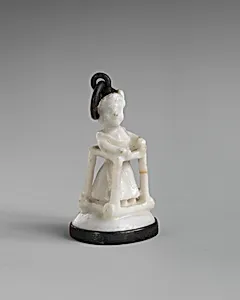
Miniature seal
ca. 1750–55
Medium
Soft-paste porcelain
Dimensions
Height: 1 1/16 in. (2.7 cm)
Classification
Ceramics-Porcelain
Culture
British, London
Department
European Sculpture and Decorative Arts
Museum
Metropolitan Museum of Art, New York, NY
Credit
Gift of Dr. and Mrs. A. L. Garbat, 1961
Accession Number
61.107.443
Rights
Public Domain
Tags
Art Historical Context
Nestled in the Metropolitan Museum of Art's European Sculpture and Decorative Arts, this *Miniature Seal* from London's Saint James's Factory (. 1750–55) exemplifies the exquisite finesse of mid-18th-century British. Crafted from soft-paste porcelain—a fragile, creamy material blending clay, glass frit, and soapstone—this diminutive gem stands just 1 1/16 inches (2.7 cm) tall. Soft-paste was Europe's ingenious workaround to true Chinese hard-paste porcelain, allowing factories like Saint James's to produce delicate, translucent wares before the hard-paste formula was perfected. Saint James's Factory, active in the 1750s, catered to a growing elite fascination with ornamental ceramics amid Britain's "porcelain fever." This miniature likely served as a charming desk accessory or seal for wax impressions, its whimsical motifs of girls and seals (perhaps playful figures or animals) capturing the Rococo era's love for dainty, narrative vignettes. The hand-modeled details and subtle glazing highlight the artisans' skill in firing such tiny forms without distortion, making it a testament to technical innovation and cultural delight. Gifted to the Met in 1961 by Dr. and Mrs. A. L. Garbat, this piece invites visitors to marvel at how everyday luxury objects embodied 18th-century British ingenuity and whimsy.
About the Artist
Saint James's Factory · 1749–1759
**Saint James's Factory: A Jewel in Early English Porcelain** The Saint James's Factory, a pioneering British porcelain manufactory, emerged in London around 1749 under the direction of Charles Gouyn, a Huguenot jeweler from Dieppe who died in 1785. Operating from premises near the Turk's Head on Bennett Street in St. James's until about 1759, Gouyn had previously collaborated with Nicholas Sprim...