
Miniature seal in the form of Cupid
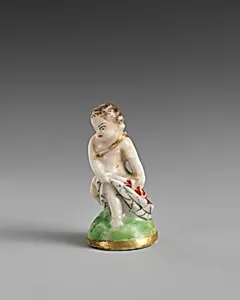
Medium
Soft-paste porcelain
Dimensions
Height: 1 1/8 in. (2.9 cm)
Classification
Ceramics-Porcelain
Culture
British, Chelsea-Derby
Department
European Sculpture and Decorative Arts
Museum
Metropolitan Museum of Art, New York, NY
Credit
Gift of Dr. and Mrs. A. L. Garbat, 1961
Accession Number
61.107.433
Rights
Public Domain
Tags
Art Historical Context
Delight in the playful elegance of this *Miniature seal in the form of Cupid crafted around 1770 by the renowned Chelsea-Derby Porcelain Manufactory. from the merger of London's Chelsea Porcelain Works (active 1743–1769) and Derby's innovative factory (founded 1750), this piece captures the height of British porcelain production during the late 18th century. just 1 1/8 inches (2.9 cm) tall, the chubby, winged Cupid—Roman god of love—stands poised with bow and arrow, embodying the Rococo spirit of whimsy and romance popular among Europe's elite. Fashioned from soft-paste porcelain, a prized English innovation blending clay with ground glass and fired at lower temperatures than true hard-paste, the seal showcases exquisite technical finesse. Its delicate modeling allowed for intricate details like Cupid's flowing hair and feathered wings, while serving a practical purpose: imprinting wax seals on letters or documents. This fusion of utility and artistry highlights Chelsea-Derby's rivalry with German Meissen porcelain, adapting Continental styles for British tastes. A cherished gift to the Metropolitan Museum of Art in 1961 from Dr. and Mrs. A. L. Garbat, this tiny treasure invites visitors to appreciate the miniaturist's mastery and the enduring allure of Cupid's mischievous charm in decorative arts.
About the Artist
Derby Porcelain Manufactory|Chelsea Porcelain Manufactory · 1751–1785
The Derby Porcelain Manufactory stands as one of the foundational institutions of British ceramic art, producing some of the finest figures and tablewares made in England during the eighteenth and early nineteenth centuries. Its origins can be traced to the work of André Planché, a Huguenot immigrant from Saxony who settled in Derby around 1745 and began producing soft-paste porcelain figures and ...