
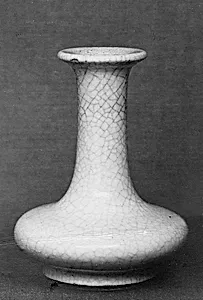
Miniature Vase
Unknown Artist
19th century
Medium
Soft paste porcelain
Dimensions
H. 2 5/8 in. (6.7 cm)
Classification
Snuff Bottles
Culture & Period
China · Qing dynasty
Department
Asian Art
Museum
Metropolitan Museum of Art, New York, NY
Credit
Bequest of Benjamin Altman, 1913
Accession Number
14.40.518
Rights
Public Domain
Art Historical Context
This exquisite Miniature Vase, in 19th-century Qing dynasty China, is a snuff bottle designed for carrying powdered tobacco—a luxury introduced by European traders and embraced by the Chinese elite. Standing just 2 5/8 inches (6.7 cm) tall, diminutive vessels were for their portability and served as status symbols among scholars and officials, who tapped out snuff through a tiny spoon. Produced during the late Qing period (1644–1912), when artisanal workshops flourished in cities like Jingdezhen, this piece exemplifies the era's mastery of miniature forms. Made from soft-paste porcelain—a finer, more translucent alternative to traditional hard-paste—this snuff bottle highlights innovative ceramic techniques that allowed for intricate molding and subtle glazing. Soft-paste, with its kaolin-feldspar body fired at lower temperatures, enabled delicate shapes impractical in denser wares, reflecting Qing potters' experimentation amid evolving tastes and trade influences. Now in the Metropolitan Museum of Art's Asian Art Department, thanks to the 1913 bequest of collector Benjamin Altman, this anonymous work invites us to appreciate the Qing court's blend of functionality and refinement. Though decoration details are unrecorded, its survival speaks to the enduring allure of these tiny treasures.