
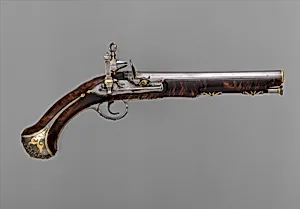
Miquelet Pistol
ca. 1790–1807
Medium
Steel, gold, wood (walnut)
Dimensions
Caliber, .665 in, (16.89 mm) Weight, 1 lb. 12 oz. (800 g) Length, 14 11/16 in. (37.31 cm) Length of barrel, 8 13/16 in. (22.38 cm)
Classification
Firearms-Pistols
Culture
Spanish, Barcelona
Department
Arms and Armor
Museum
Metropolitan Museum of Art, New York, NY
Credit
Rogers Fund, 1937
Accession Number
37.154.5
Rights
Public Domain
Art Historical Context
Step into the Arms and Armor gallery at The Metropolitan Museum of Art, where the *Miquelet Pistol* (ca. 1790–1807) showcases the masterful gunsmithing of Barcelona, Spain. Crafted by Llorens Torrens and Jacinto Jaumeandreu, this pistol exemplifies the late flintlock era, named for its distinctive "miquelet" lock mechanism—a Spanish innovation popular from the 17th to 19th centuries. Originating in Catalonia, these firearms were favored by miquelet irregular troops during the Napoleonic Wars and by civilians for self-defense, blending rugged functionality with regional pride. The pistol's construction highlights exquisite artistry in steel, gold, and walnut wood. Its 8 13/16-inch barrel (caliber .665 in.) and overall length of 14 11/16 inches make it compact yet powerful, weighing just 1 lb. 12 oz. Gold inlays likely adorn the barrel and lock, a hallmark of Barcelona's luxury gun trade, while the finely figured walnut stock provides ergonomic balance and aesthetic warmth. This combination reflects the era's fusion of military utility and ornamental skill, positioning Barcelona as a Mediterranean hub for fine firearms. Acquired through the Rogers Fund in 1937, this pistol invites visitors to ponder the artistry of conflict—where engineering meets elegance in Spain's turbulent history. A testament to 18th-century innovation, it reminds us how weapons doubled as status symbols for the elite.
About the Artist
Llorens Torrens|Jacinto Jaumeandreu (Spanish|Spanish) · 1793 |1725 –1824 |1832
Spanish, Catalonia, active 1793–1824|Spanish, Catalonia, active about 1750–1807