
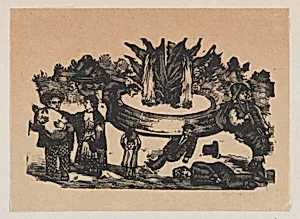
Miraculous fountain
ca 1890–1910
Medium
Type-metal engraving
Dimensions
Sheet: 2 3/4 × 4 1/2 in. (7 × 11.5 cm)
Classification
Prints
Department
Drawings and Prints
Museum
Metropolitan Museum of Art, New York, NY
Credit
The Elisha Whittelsey Collection, The Elisha Whittelsey Fund, 1946
Accession Number
46.46.420
Rights
Public Domain
Tags
Art Historical Context
This small but evocative type-metal engraving, created around 1890–1910 by José Guadalupe Posada in collaboration with Manuel Manilla, captures a lively scene of men, women, and children gathered around a fountain. Measuring just 2 ¾ by 4 ½ inches, the print exemplifies the accessible, mass-produced imagery that defined Mexican popular graphics during the late Porfiriato and the early years of the Mexican Revolution. Posada, renowned for his bold, satirical style, and Manilla, a skilled printmaker, used the durable type-metal engraving technique to produce affordable broadsides that reached wide audiences beyond elite galleries. The work reflects the vibrant tradition of Mexican printmaking, where artists combined religious, folkloric, and everyday subjects to comment on society. Fountains often symbolized life, community, and sometimes miraculous events in Mexican visual culture, and this piece likely served both as entertainment and subtle social observation. Its modest scale and crisp lines made it ideal for distribution in newspapers, flyers, or chapbooks. Housed today in the Metropolitan Museum of Art’s Department of Drawings and Prints as part of the Elisha Whittelsey Collection, the engraving preserves a snapshot of turn-of-the-century Mexican life. It highlights how Posada and Manilla transformed simple materials into powerful vehicles for cultural storytelling, influencing later generations of artists who valued printmaking as a democratic art form.
About the Artist
José Guadalupe Posada|Manuel Manilla · 1852–1913
José Guadalupe Posada (1852-1913) was a Mexican printmaker and engraver who revolutionized popular art and created some of the most iconic images in Mexican culture. Working primarily with publisher Antonio Vanegas Arroyo, he produced over 20,000 images during his career—inexpensive broadsheets sold for a penny on colored paper that made his art accessible to even the poorest workers. He transform...