
God Belly
1921
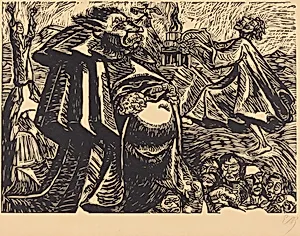
Medium
woodcut
Dimensions
image: 25.7 x 35.8 cm (10 1/8 x 14 1/8 in.)
Classification
Portfolio
Department
CG-W
Museum
National Gallery of Art, Washington, D.C.
Credit
Rosenwald Collection
Accession Number
1954.12.211
Rights
Public Domain
Art Historical Context
Ernst Barlach's *God Belly* (1921) is a compelling woodcut from the early Weimar Republic era, a time of social upheaval in post-World War I Germany. Bar, a leading figure in German Expressionism, was renowned for his sculptures and prints distilled raw human emotion and depth into stark, monumental forms. This provocative title hints at the artist's penchant for bold, sometimes satirical explorations of divinity, humanity, and the grotesque, challenging viewers to confront the absurdities of existence. ed as a woodcut 25.7 x 35.8 cm, the work leverages the medium's rustic power: carved into wood blocks and hand-printed, it yields dramatic black-and-white contrasts and textured lines that amplify emotional intensity. Woodcuts, favored by Expressionists for their directness and folk-art roots, allowed Barlach to bypass fine detail in favor of visceral impact, echoing medieval prints while speaking to modern turmoil. Housed in the National Gallery of Art's Rosenwald Collection as part of a portfolio (Department: CG-W), *God Belly* reflects Barlach's innovative printmaking amid rising cultural tensions—he would later face Nazi persecution for his "degenerate" art. For visitors, it offers a window into Expressionism's unflinching gaze, inviting reflection on faith, form, and the human condition.
About the Artist
Ernst Barlach · 1870–1938
Ernst Barlach (1870–1938) was one of the most powerful German Expressionist sculptors of the early twentieth century, an artist whose work fused medieval spirituality with modern existential anguish to produce images of haunting emotional force. Born in Wedel, Holstein, Barlach studied at the Hamburg School of Applied Arts and later at the Dresden Academy of Fine Arts before traveling to Paris, wh...