
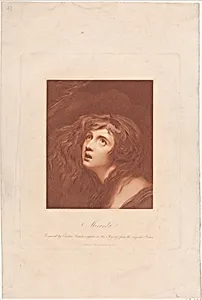
Miranda (Shakespeare, The Tempest, Act 1, Scene 1)
Medium
Stipple with etching; printed in brown ink
Dimensions
Image: 8 1/16 × 6 11/16 in. (20.5 × 17 cm) Plate: 12 3/8 × 10 1/16 in. (31.4 × 25.6 cm) Sheet: 18 13/16 × 12 5/8 in. (47.8 × 32 cm)
Classification
Prints
Department
Drawings and Prints
Museum
Metropolitan Museum of Art, New York, NY
Credit
Rogers Fund, 1962
Accession Number
62.602.675
Rights
Public Domain
Tags
Art Historical Context
This stipple engraving with etching, printed in warm brown ink in 1809, captures Miranda from Shakespeare’s *The Tempest*, I, Scene I. The image portrays the young heroine in a moment of wonder and vulnerability amid the storm, reflecting the play’s themes of innocence confronting nature’s fury. Created during a period when Shakespeare’s works enjoyed renewed popularity in British art and theater, the print translates a painted composition into an accessible format for wider audiences. Caroline Watson, a skilled engraver, produced the work after a design associated with George Romney, who often featured Lady Emma Hamilton as his model. Hamilton’s expressive features lend the figure a lively, theatrical presence typical of late 18th-century portraiture. The stipple technique—tiny dots combined with etched lines—allowed for delicate tonal gradations and soft textures, making the print both intimate and luminous. Housed in the Metropolitan Museum of Art’s Department of Drawings and Prints, this sheet exemplifies how reproductive prints helped disseminate Shakespearean imagery across Georgian England. Its modest scale and refined technique made such works suitable for private collections, extending the cultural reach of both the playwright and the artists involved.
About the Artist
Caroline Watson|George Romney|Lady Emma Hamilton|William Hayley|William Shakespeare|Thomas Payne (British|Flemish) · 1760 |1577 –1814 |1640
British, London 1760/61–1814 London|Flemish, Siegen 1577–1640 Antwerp