
Mirror Frame with Tree of Life Motif
Mughal dynasty (1526-1857), 17th/18th century
Medium
Nephrite jade, gold, rubies, emeralds, and diamonds inset in the kundan technique
Dimensions
16.4 × 10.2 × 1 cm (6 7/16 × 4 × 3/8 in.)
Classification
mirror
Department
Arts of Asia
Museum
Art Institute of Chicago
Accession Number
34286
Rights
Public Domain
About this artwork
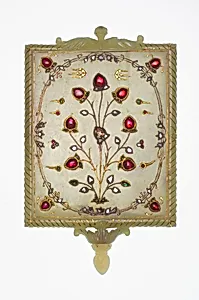
This exquisite Mughal mirror frame of pale-green nephrite jade is inlaid with gems in the kundan technique, a quintessentially Indian method of gem setting. The motif of this luxury item designed for the Mughal court is a tree of life with inlaid gold stems and leaves and buds of rubies, diamonds, and emeralds. Above the naturalistically depicted plant are two abstracted Chinese-style clouds in gold. Acanthus-leaf motifs adorn the top and bottom of the frame, while the mirror handle is in the sh...
Art Historical Context
Step into the opulent world of the Mughal Empire with this exquisite *Mirror Frame with Tree of Life Motif*, crafted in the 17th or 18th century during the dynasty's golden age (1526–1857). Produced in the royal workshops of India, this compact treasure—measuring just 16.4 × 10.2 × 1 cm—exemplifies the Mughals' fusion of Persian, Islamic, and Indian aesthetics. The Tree of Life, a recurring motif symbolizing eternal growth, fertility, and paradise, adorns the nephrite jade frame, evoking the lush gardens of Mughal palaces and the empire's reverence for nature's abundance. Masterfully fashioned from translucent nephrite jade, the frame is embellished with gold, rubies, emeralds, and diamonds set using the kundan technique—a hallmark of Indian jewelry artistry. In kundan, uncut gems are embedded in pure gold foil without prongs, creating a seamless, radiant mosaic that catches the light like a jewel box. This labor-intensive method, favored by Mughal nobility, underscores the object's status as a luxury item, likely for a courtly vanity or personal adornment. Housed in the Art Institute of Chicago's Arts of Asia department, this mirror frame highlights the technical virtuosity and cultural splendor of Mughal decorative arts. Though the artist remains unknown, its survival speaks to the enduring allure of an era when emperors like Shah Jahan commissioned such wonders, blending artistry with imperial prestige. A true gem for visitors seeking the sparkle of history!
About the Artist
Unknown
The artist designated as "Unknown" in our virtual museum's collection exemplifies a poignant chapter in art history: creators whose identities have faded into obscurity despite the enduring power of their work. With only one known artwork attributed to them in our holdings, this figure represents countless anonymous hands that shaped visual culture across centuries. Museums worldwide, including th...