
Mise-en-carte (Point-paper)
1760/90
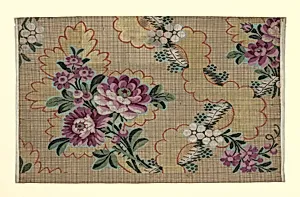
Medium
Ink and gouache on hand drawn graph paper
Dimensions
34 × 54.6 cm (13 3/8 × 21 1/2 in.)
Classification
textile
Department
Textiles
Museum
Art Institute of Chicago
Accession Number
148916
Rights
Public Domain
Art Historical Context
Step into the intricate world of 18th textile design with *Mise-en-carte (Point-paper)*, a meticulously crafted pattern from around 1760–. Created by an unknown artist using ink and gouache on-drawn graph paper, this34 × 54.6 cm sheet resides in the Art Institute of's Textiles Department. The title, French for "layout" or "pattern setup," its purpose: a blueprint for weaving complex fabrics on a drawloom, where each tiny square represents the intersection of warp and weft threads. This point-paper technique was revolutionary for its time, allowing designers to map elaborate motifs—like florals, geometrics, or damasks—before committing to costly looms. Gouache provided vibrant color cues, while the grid ensured precision, bridging artistry and engineering. Dating to the late Enlightenment era, it captures a pivotal moment when luxury textiles fueled trade and fashion across Europe, from Versailles silks to colonial exports. Today, this fragile artifact highlights the unsung skill of textile artisans, whose innovations paved the way for 19th-century mechanized looms. Imagine the weaver's anticipation as this coded paper came to life in shimmering brocade— a testament to human ingenuity in every squared stitch.
About the Artist
Unknown
The artist designated as "Unknown" in our virtual museum's collection exemplifies a poignant chapter in art history: creators whose identities have faded into obscurity despite the enduring power of their work. With only one known artwork attributed to them in our holdings, this figure represents countless anonymous hands that shaped visual culture across centuries. Museums worldwide, including th...