
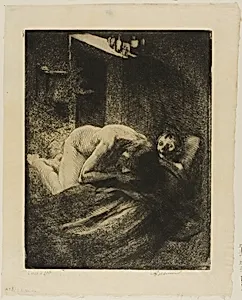
Misery, plate nine from Woman
c. 1886
Medium
Etching and aquatint in black on cream Japanese paper
Dimensions
Image/plate: 31.8 × 24.6 cm (12 9/16 × 9 11/16 in.); Sheet: 38.9 × 31 cm (15 3/8 × 12 1/4 in.)
Classification
etching
Department
Prints and Drawings
Museum
Art Institute of Chicago
Accession Number
27875
Rights
Public Domain
Art Historical Context
Albert Besnard's *Misery*, plate nine the series *Woman* (c. 1886), captures the raw emotional depth of feminine experience in late 19th-century France As a leading Symbolist printmaker, Besnard explored psychological states through evocative imagery, part of a broader fin-de-siècle fascination with introspection and the inner life. This etching reflects the era's shifting views on women, blending beauty with profound sorrow amid the cultural turbulence of post-Impressionist Paris. Printed in black ink on luxurious cream Japanese paper, the work showcases Besnard's virtuoso use of etching and aquatint techniques. Etching creates precise lines for contours and details, while aquatint produces velvety tonal gradients, evoking a misty, dreamlike atmosphere that heightens the theme of despair. Japanese paper, favored by European artists for its soft texture and ink absorption, enhances the print's subtle nuances, making it a prized example of 1880s graphic innovation. Housed in the Art Institute of Chicago's Prints and Drawings department, this 31.8 × 24.6 cm plate invites viewers to ponder universal human fragility. Besnard's series, including *Misery*, underscores his legacy as a bridge between Symbolism's emotional intensity and modernism's technical boldness.
About the Artist
Albert Besnard · 1849–1934
Paul-Albert Besnard, known as Albert Besnard, was born on June 2, 1849, in Paris to an artistic family: his father, Louis Adolphe Ferdinand Besnard, was a history painter and pupil of Ingres, while his mother, Marie Louise Pauline Vaillant, was a noted miniaturist trained under Lizinska de Mirbel. Precociously talented, he began his training under Jean-François Brémond before entering the École de...